
GCSE Biology (AQA)
331 videos | 14 hours
Please subscribe to watch this video.
This, and all other videos, are included in our premium subscriptions.
Premium accounts get access to all videos.
Enable autoplay to keep watching
Your browser is blocking videos from playing automatically. To turn it back on:
Safari (Mac): Click the Safari menu item in the top bar, then Settings → Websites → Auto-Play, then set Auto-Play to Allow All Auto-Play for the current website.
Safari (iPhone/iPad): open the Settings app, then Apps → Safari → Auto-Play, and select Allow All Auto-Play.
Accommodation
- Accommodation is the process of the lens changing shape to focus on near or distant objects.
- A diagram illustrates the eye perceiving a nearby object, such as a bird.
- To focus on near objects, the lens becomes thick; for distant objects, the lens thins.
- The eye automatically adjusts lens thickness as a reflex to focus on surrounding objects.
- This adjustment is termed accommodation, aiding in viewing objects at varying distances.
- Light entering the lens at an angle changes direction, similar to cars moving from pavement to sand.
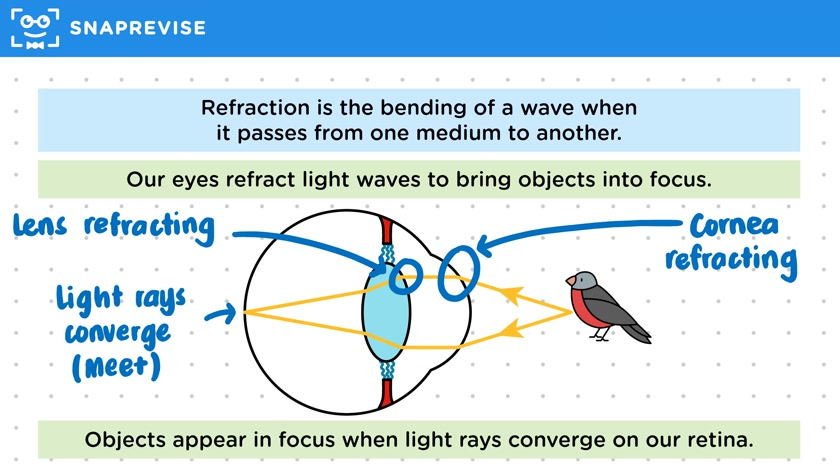
- This bending of light is called refraction, which helps focus light on the retina.
- The cornea consistently refracts light into the pupil, while the lens adjusts its shape to further focus light onto the retina.
- Objects appear in focus when light waves converge on the retina; otherwise, they appear blurry.
- Near objects require the lens to be thicker to refract light more due to the wider angle of incoming light, aiding in convergence on the retina.
- Far objects, with nearly parallel light waves by the time they reach the eye, require less refraction.
- Lens shape is controlled by ciliary muscles and suspensory ligaments.
- When viewing distant objects, suspensory ligaments are tight, and ciliary muscles are relaxed, resulting in a thin lens.
- Conversely, for near objects, suspensory ligaments are loose, and ciliary muscles are contracted, resulting in a thicker lens.
- A table summarizes the changes: for near objects, ciliary muscles contract, suspensory ligaments loosen, and the lens is thick; for far objects, ciliary muscles relax, suspensory ligaments tighten, and the lens is thin.
- Proper vocabulary is crucial: ligaments tighten (not contract) and muscles relax (not loosen).
Please subscribe to access these revision notes.
This, and all other video notes, are included in our premium subscriptions.
Premium accounts get access to all videos and revision notes.
162
questions for Homeostasis and response
51
questions for The human nervous system