
GCSE Biology (AQA)
331 videos | 14 hours
Please subscribe to watch this video.
This, and all other videos, are included in our premium subscriptions.
Premium accounts get access to all videos.
Enable autoplay to keep watching
Your browser is blocking videos from playing automatically. To turn it back on:
Safari (Mac): Click the Safari menu item in the top bar, then Settings → Websites → Auto-Play, then set Auto-Play to Allow All Auto-Play for the current website.
Safari (iPhone/iPad): open the Settings app, then Apps → Safari → Auto-Play, and select Allow All Auto-Play.
Adult Cell Cloning
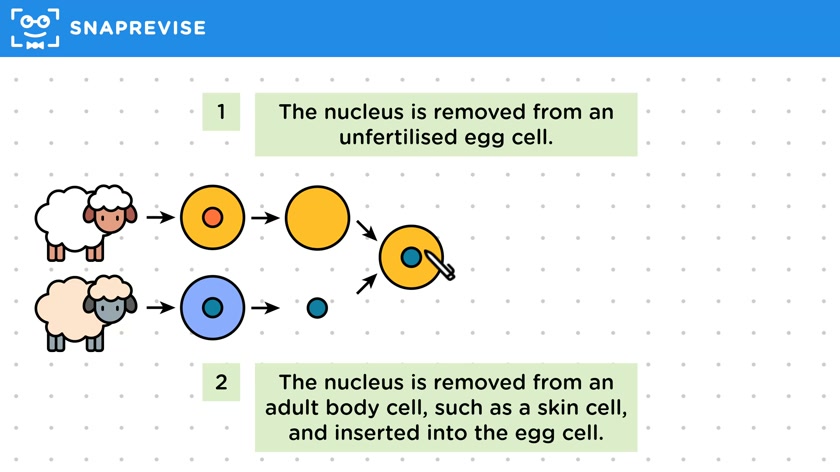
- Adult cell cloning involves replacing the nucleus of an unfertilized egg cell with a nucleus from an adult body cell.
- Dolly the sheep was the most famous animal cloned using this method and was the first mammal successfully cloned in 1996.
- The process starts by removing the nucleus from an unfertilized egg cell.
- The nucleus from an adult body cell, such as a skin cell, is then inserted into the egg cell.
- The resulting cell, containing parts from two different cells, now has a new nucleus from the adult body cell.
- An electric shock is used to stimulate the egg cell to divide and form an embryo.
- The embryo cells contain the same genetic information as the adult skin cell because they are made from the division of the cell containing the adult body cell nucleus.
- The embryo is then inserted into the womb of an adult female to continue its development.
- A clone is born identical to the animal from which the nucleus was taken, resulting in a lamb that looks exactly the same as the sheep from which it was cloned.
Please subscribe to access these revision notes.
This, and all other video notes, are included in our premium subscriptions.
Premium accounts get access to all videos and revision notes.
114
questions for Inheritance, variation and evolution
47
questions for Variation and evolution