
GCSE Biology (AQA)
331 videos | 14 hours
Please subscribe to watch this video.
This, and all other videos, are included in our premium subscriptions.
Premium accounts get access to all videos.
Enable autoplay to keep watching
Your browser is blocking videos from playing automatically. To turn it back on:
Safari (Mac): Click the Safari menu item in the top bar, then Settings → Websites → Auto-Play, then set Auto-Play to Allow All Auto-Play for the current website.
Safari (iPhone/iPad): open the Settings app, then Apps → Safari → Auto-Play, and select Allow All Auto-Play.
Anti-Diuretic Hormone (ADH)
- Antidiuretic hormone (ADH) controls the water content of the blood by regulating urine volume.
- Diuretic substances like coffee and alcohol increase urine water content, leading to more frequent urination and dehydration.
- ADH works oppositely by decreasing water in the urine, making it more concentrated with solutes like ions, glucose, and urea.
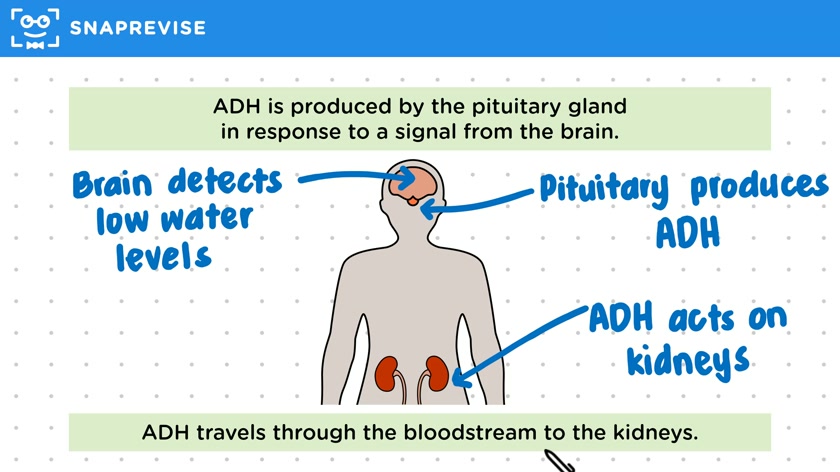
- ADH is produced by the pituitary gland in response to low water levels in the blood, detected by the brain.
- The pituitary gland, known as the master gland, releases hormones that act on other glands in the body.
- ADH travels through the bloodstream to the kidneys, the target organ for ADH.
- In the kidneys, ADH increases the permeability of kidney tubules, allowing more water to be reabsorbed into the blood and less water to be lost in urine.
- The action of ADH is an example of negative feedback, aiming to maintain a healthy level of water in the blood.
- When water levels are low, the pituitary gland releases more ADH; when levels are high, it reduces ADH release, helping balance water levels in the body.
Please subscribe to access these revision notes.
This, and all other video notes, are included in our premium subscriptions.
Premium accounts get access to all videos and revision notes.
162
questions for Homeostasis and response
99
questions for Hormonal coordination in humans