
GCSE Biology (AQA)
331 videos | 14 hours
Please subscribe to watch this video.
This, and all other videos, are included in our premium subscriptions.
Premium accounts get access to all videos.
Enable autoplay to keep watching
Your browser is blocking videos from playing automatically. To turn it back on:
Safari (Mac): Click the Safari menu item in the top bar, then Settings → Websites → Auto-Play, then set Auto-Play to Allow All Auto-Play for the current website.
Safari (iPhone/iPad): open the Settings app, then Apps → Safari → Auto-Play, and select Allow All Auto-Play.
Bacterial Cell Structure
- Bacteria are microscopic single-cell organisms.
- Examples include Salmonella, MRSA, and Gonorrhea.
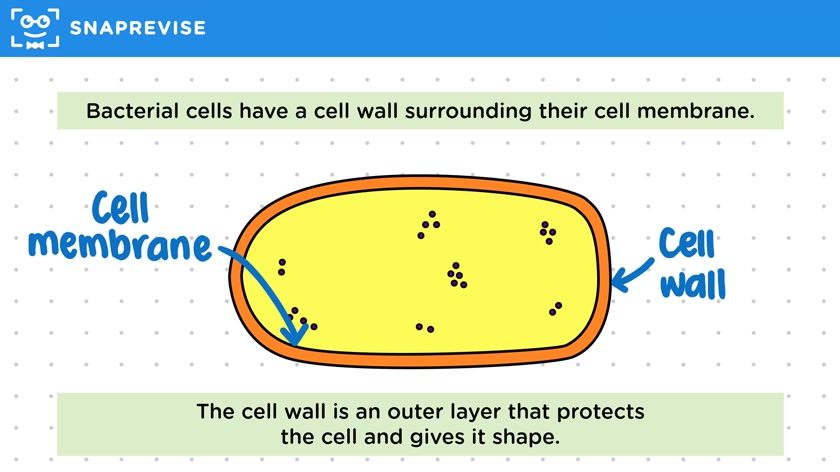
- Bacterial cells contain a cell membrane, cytoplasm, and ribosomes, similar to animal and plant cells.
- The cell membrane surrounds the cell, the cytoplasm fills the interior, and ribosomes float within the cytoplasm.
- Ribosomes in bacterial cells function similarly to those in animal and plant cells.
- Bacterial cells also have a cell wall that provides protection and shape, located outside the cell membrane.
- Unlike plant cells, the bacterial cell wall is not made of cellulose.
- Bacterial DNA is free-floating within the cytoplasm, typically forming a single DNA loop and possibly additional smaller loops called plasmids.
- Bacteria are prokaryotes, believed to have evolved around 3.5 billion years ago.
- For exam purposes, students need to recognize and understand the structure and function of these bacterial components but not the details of bacterial evolution or the composition of the cell wall.
- Under an electron microscope, bacterial structures like the cell wall, cell membrane, cytoplasm, ribosomes, DNA loop, and plasmids can be observed, though they appear different from simplified diagrams.
- Exam questions typically focus on identifying these organelles in simple drawings rather than detailed microscopic images.
Please subscribe to access these revision notes.
This, and all other video notes, are included in our premium subscriptions.
Premium accounts get access to all videos and revision notes.
145
questions for Cell biology
27
questions for Cell structure