
GCSE Biology (AQA)
331 videos | 14 hours
Please subscribe to watch this video.
This, and all other videos, are included in our premium subscriptions.
Premium accounts get access to all videos.
Enable autoplay to keep watching
Your browser is blocking videos from playing automatically. To turn it back on:
Safari (Mac): Click the Safari menu item in the top bar, then Settings → Websites → Auto-Play, then set Auto-Play to Allow All Auto-Play for the current website.
Safari (iPhone/iPad): open the Settings app, then Apps → Safari → Auto-Play, and select Allow All Auto-Play.
Bacterial Population Size
- Bacterial populations double with each reproduction cycle.
- The final number of bacteria is calculated as the initial number multiplied by two raised to the power of the number of divisions.
- Example given over a 60-minute period starting with one bacterium:
- At 0 minutes: 1 bacterium
- At 20 minutes: 2 bacteria
- At 40 minutes: 4 bacteria
- At 60 minutes: 8 bacteria
- The formula used for calculation is: final bacteria count = initial count * (2 ^ number of divisions).
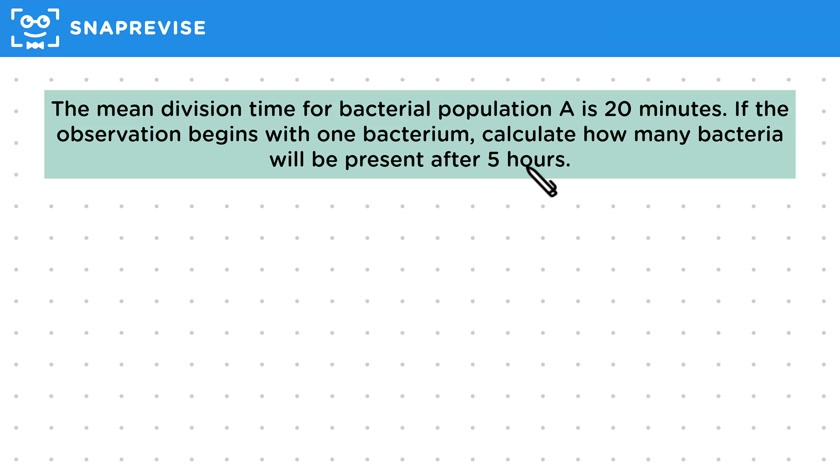
- Mean division time for the example bacteria is 20 minutes.
- To find out how many bacteria are present after five hours:
- Calculate divisions per hour: 60 minutes / 20 minutes = 3 divisions per hour.
- Multiply by total hours: 3 divisions/hour * 5 hours = 15 divisions.
- Apply the formula: 1 * (2 ^ 15) = 32,768 bacteria.
- Students are expected to memorize this formula and perform such calculations in exams.
Please subscribe to access these revision notes.
This, and all other video notes, are included in our premium subscriptions.
Premium accounts get access to all videos and revision notes.
145
questions for Cell biology
27
questions for Cell structure