
GCSE Biology (AQA)
331 videos | 14 hours
Please subscribe to watch this video.
This, and all other videos, are included in our premium subscriptions.
Premium accounts get access to all videos.
Enable autoplay to keep watching
Your browser is blocking videos from playing automatically. To turn it back on:
Safari (Mac): Click the Safari menu item in the top bar, then Settings → Websites → Auto-Play, then set Auto-Play to Allow All Auto-Play for the current website.
Safari (iPhone/iPad): open the Settings app, then Apps → Safari → Auto-Play, and select Allow All Auto-Play.
Benefits & Risks of Cloning
- Cloning has both potential benefits and risks in agriculture and medicine.
- Benefits and risks of cloning overlap with those of selective breeding and asexual reproduction.
- Cloning produces offspring with known characteristics quickly, faster than selective breeding.
- Cloning can be used to preserve endangered species by enabling reproduction when few individuals remain.
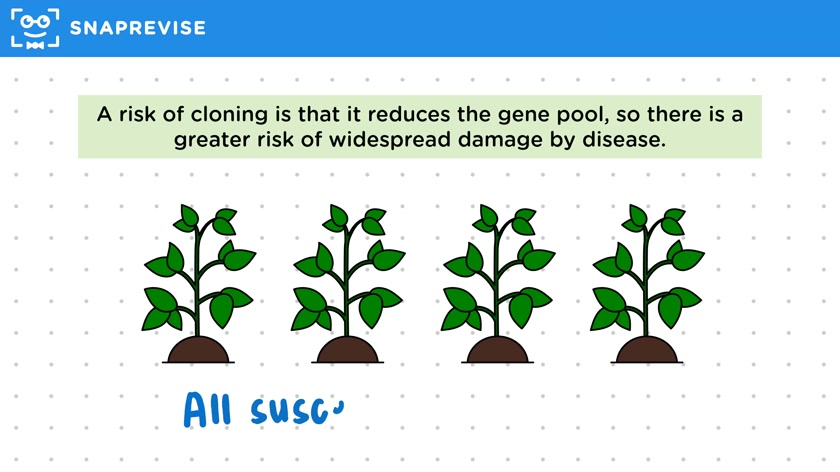
- A risk of cloning is the reduction of the gene pool, increasing susceptibility to widespread disease damage.
- Cloned organisms (CLOs) may not be as healthy as the original, exemplified by Dolly the sheep who died younger than her donor.
- Benefits of cloning include quick reproduction of desired traits and preservation of endangered species.
- Risks include reduced genetic diversity leading to disease vulnerability and potentially poorer health of clones.
- Students are advised to familiarize themselves with the benefits and risks of cloning for exam preparation.
Please subscribe to access these revision notes.
This, and all other video notes, are included in our premium subscriptions.
Premium accounts get access to all videos and revision notes.
114
questions for Inheritance, variation and evolution
47
questions for Variation and evolution