
GCSE Biology (AQA)
331 videos | 14 hours
Please subscribe to watch this video.
This, and all other videos, are included in our premium subscriptions.
Premium accounts get access to all videos.
Enable autoplay to keep watching
Your browser is blocking videos from playing automatically. To turn it back on:
Safari (Mac): Click the Safari menu item in the top bar, then Settings → Websites → Auto-Play, then set Auto-Play to Allow All Auto-Play for the current website.
Safari (iPhone/iPad): open the Settings app, then Apps → Safari → Auto-Play, and select Allow All Auto-Play.
Defining Diffusion
- Diffusion is the spreading out of particles of a gas or any substance in solution.
- Example given: Pouring chlorine into a swimming pool results in a high concentration at the point of entry and a lower concentration further away.
- Diffusion causes a net movement of a substance from an area of higher concentration to an area of lower concentration.
- Particles move randomly but show a net movement from high to low concentration areas.
- Particles continue moving even after the animation stops, simulating continuous diffusion in real life.
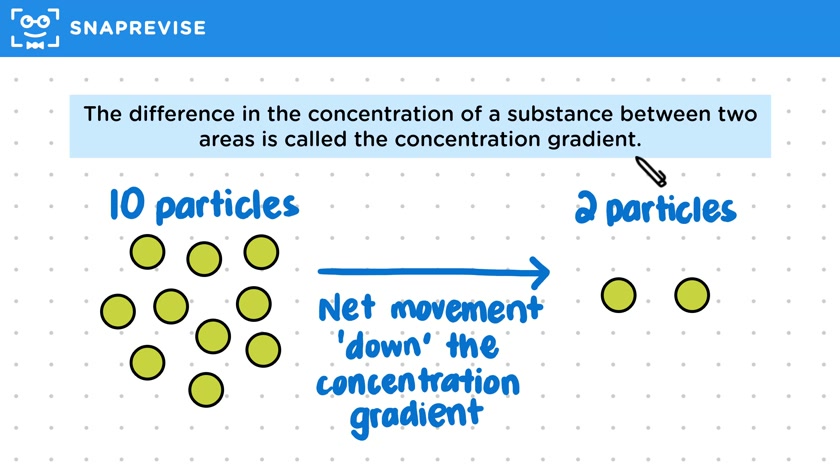
- The difference in concentration between two areas is termed the concentration gradient.
- Particles move down or with their concentration gradient.
- When concentration is the same on both sides, there is no net movement, and particles reach equilibrium.
- Diffusion into and out of cells is a passive process, requiring no energy.
- Substances like oxygen, carbon dioxide, and urea move across cell membranes by diffusion.
- The cell membrane is partially permeable, allowing selective movement of substances in and out of cells.
Please subscribe to access these revision notes.
This, and all other video notes, are included in our premium subscriptions.
Premium accounts get access to all videos and revision notes.
145
questions for Cell biology
64
questions for Transport in cells