
GCSE Biology (AQA)
331 videos | 14 hours
Please subscribe to watch this video.
This, and all other videos, are included in our premium subscriptions.
Premium accounts get access to all videos.
Enable autoplay to keep watching
Your browser is blocking videos from playing automatically. To turn it back on:
Safari (Mac): Click the Safari menu item in the top bar, then Settings → Websites → Auto-Play, then set Auto-Play to Allow All Auto-Play for the current website.
Safari (iPhone/iPad): open the Settings app, then Apps → Safari → Auto-Play, and select Allow All Auto-Play.
Diffusion in the Intestines
- Diffusion is crucial for nutrient absorption during digestion.
- The digestive system consists of various organs including the stomach, liver, and intestines.
- Knowledge of the digestive system from key stage three science is assumed for GCSE biology.
- Nutrients, such as glucose, are primarily absorbed in the small intestine.
- The small intestine is depicted in the diagram with squiggly, darker pink lines, while the large intestine has a larger diameter and a straighter path.
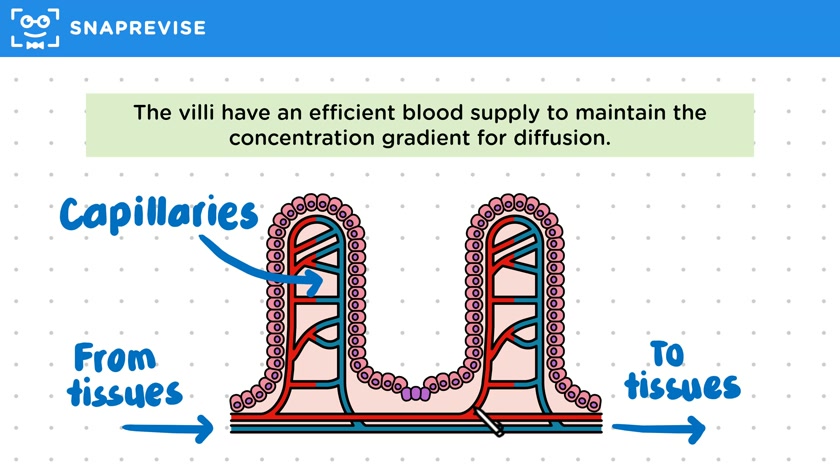
- The small intestine is adapted for nutrient absorption with structures called villi (singular: villus), which have a thin membrane and a large surface area to volume ratio.
- Villi are lined with capillaries that facilitate molecule exchange and maintain a concentration gradient essential for diffusion.
- Blood flow in the intestines helps maintain the concentration gradient by constantly moving, allowing nutrients to diffuse into the blood.
- After a meal, glucose concentration is high in the lumen of the small intestine and diffuses into the blood due to the concentration gradient.
- The absorbed glucose is then transported by the blood from the intestines to respiring tissues and organs throughout the body.
Please subscribe to access these revision notes.
This, and all other video notes, are included in our premium subscriptions.
Premium accounts get access to all videos and revision notes.
145
questions for Cell biology
64
questions for Transport in cells