
GCSE Biology (AQA)
331 videos | 14 hours
Please subscribe to watch this video.
This, and all other videos, are included in our premium subscriptions.
Premium accounts get access to all videos.
Enable autoplay to keep watching
Your browser is blocking videos from playing automatically. To turn it back on:
Safari (Mac): Click the Safari menu item in the top bar, then Settings → Websites → Auto-Play, then set Auto-Play to Allow All Auto-Play for the current website.
Safari (iPhone/iPad): open the Settings app, then Apps → Safari → Auto-Play, and select Allow All Auto-Play.
DNA Base Pairing
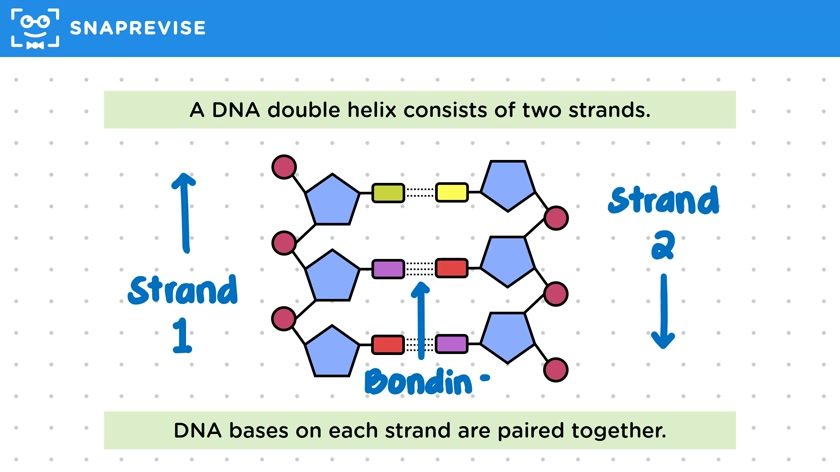
- A DNA double helix consists of two strands.
- Strand one is on the left and strand two is on the right in the diagram.
- The two strands run in opposite directions.
- Strand two appears upside down or reversed compared to strand one.
- DNA bases on each strand are paired together through hydrogen bonding.
- Specific base pairing: Adenine (A) always pairs with Thymine (T), and Guanine (G) pairs with Cytosine (C).
- These are referred to as complementary pairings, making the strands complementary to each other.
- It is important to know the base pairings for exams, but the type of bonding (hydrogen bonding) does not need to be described in the exam.
Please subscribe to access these revision notes.
This, and all other video notes, are included in our premium subscriptions.
Premium accounts get access to all videos and revision notes.
114
questions for Inheritance, variation and evolution
19
questions for Reproduction