
GCSE Biology (AQA)
331 videos | 14 hours
Please subscribe to watch this video.
This, and all other videos, are included in our premium subscriptions.
Premium accounts get access to all videos.
Enable autoplay to keep watching
Your browser is blocking videos from playing automatically. To turn it back on:
Safari (Mac): Click the Safari menu item in the top bar, then Settings → Websites → Auto-Play, then set Auto-Play to Allow All Auto-Play for the current website.
Safari (iPhone/iPad): open the Settings app, then Apps → Safari → Auto-Play, and select Allow All Auto-Play.
Drawing Punnett Squares
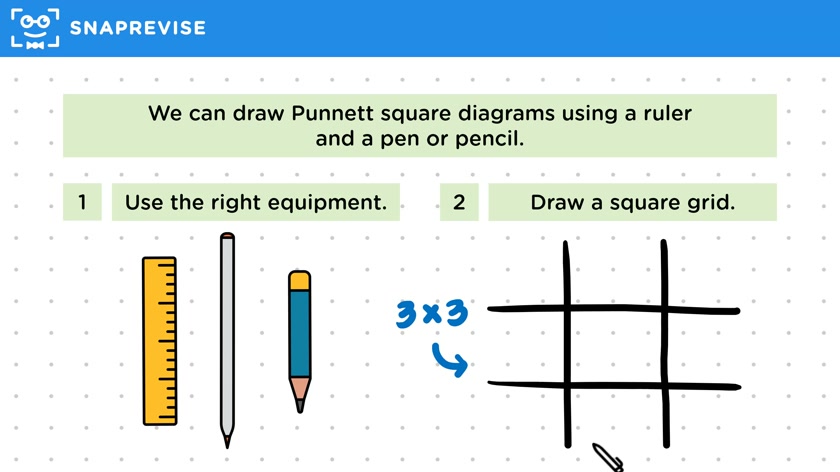
- Punnet square diagrams can be drawn using a ruler and a pen or pencil.
- Constructing Punnet squares allows for predictions about the probability of different genetic outcomes.
- Essential tools for drawing a Punnet square include a ruler, pen, or pencil.
- Begin by drawing a square grid that is three boxes long and three boxes wide, suitable for a simple genetic cross.
- This type of diagram is known as a Punnett square in GCSE biology, named after Reginald Punnett.
- Write the genotypes of the parents on the diagram, with one parent's genotype along the top and the other's down the side.
- Dominant alleles are represented by an uppercase letter and are written first in any allele combination.
- After setting up the genotypes, combine the rows and columns to fill in the square.
- Interpret the results of the genetic cross, which in the example includes one homozygous dominant, one homozygous recessive, and two heterozygous outcomes.
Please subscribe to access these revision notes.
This, and all other video notes, are included in our premium subscriptions.
Premium accounts get access to all videos and revision notes.
114
questions for Inheritance, variation and evolution
19
questions for Reproduction