
GCSE Biology (AQA)
331 videos | 14 hours
Please subscribe to watch this video.
This, and all other videos, are included in our premium subscriptions.
Premium accounts get access to all videos.
Enable autoplay to keep watching
Your browser is blocking videos from playing automatically. To turn it back on:
Safari (Mac): Click the Safari menu item in the top bar, then Settings → Websites → Auto-Play, then set Auto-Play to Allow All Auto-Play for the current website.
Safari (iPhone/iPad): open the Settings app, then Apps → Safari → Auto-Play, and select Allow All Auto-Play.
Efficiency of Biomass Transfers
- Biomass transfer efficiency between trophic levels can be calculated using percentages or fractions of mass.
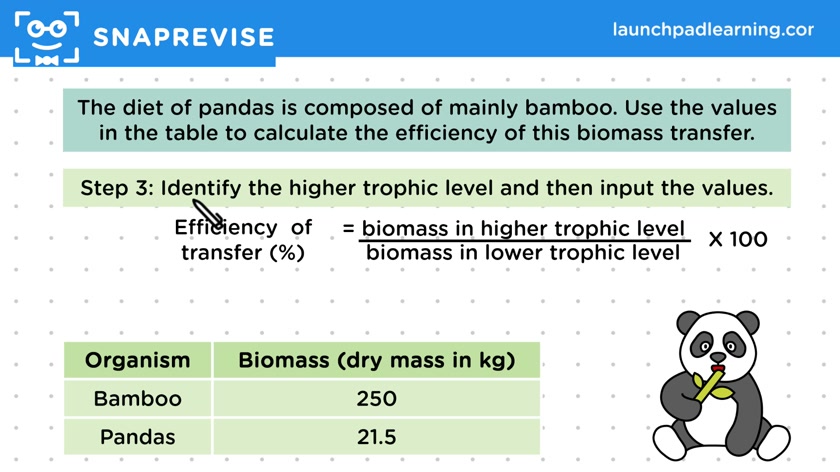
- Efficiency of transfer as a percentage is calculated by dividing the biomass in a higher trophic level by the biomass in a lower trophic level and then multiplying by 100.
- A pyramid of biomass illustrates the biomass at each level of a food chain, including a tree, aphids, birds, and a hawk.
- The example considers the transfer of mass from a tree (100% mass) to aphids and subsequent levels.
- The example uses pandas and their diet of bamboo to demonstrate how to calculate biomass transfer efficiency.
- Steps to calculate efficiency:
- 1. Identify the command word in the question (e.g., "calculate").
- 2. Write out the equation needed for calculation.
- 3. Identify the higher trophic level and input the values.
- 4. Calculate the answer and include the units.
- 5. Use the fact that no more than 100% of biomass can be transferred to check the answer.
- Approximately 10% of biomass is normally transferred between trophic levels.
- The calculated example shows an 8.6% efficiency of biomass transfer from bamboo to pandas, aligning with expected values.
Please subscribe to access these revision notes.
This, and all other video notes, are included in our premium subscriptions.
Premium accounts get access to all videos and revision notes.
61
questions for Ecology
15
questions for Trophic levels in an ecosystem (biology only)