
GCSE Biology (AQA)
331 videos | 14 hours
Please subscribe to watch this video.
This, and all other videos, are included in our premium subscriptions.
Premium accounts get access to all videos.
Enable autoplay to keep watching
Your browser is blocking videos from playing automatically. To turn it back on:
Safari (Mac): Click the Safari menu item in the top bar, then Settings → Websites → Auto-Play, then set Auto-Play to Allow All Auto-Play for the current website.
Safari (iPhone/iPad): open the Settings app, then Apps → Safari → Auto-Play, and select Allow All Auto-Play.
Evaluating Contraception
- Different contraception methods vary in effectiveness, side effects, and protection against sexually transmitted infections (STIs).
- Personal circumstances, including cost, religious beliefs, and ease of use, influence the choice of contraception.
- In the UK, most contraceptives are free, reducing the cost barrier.
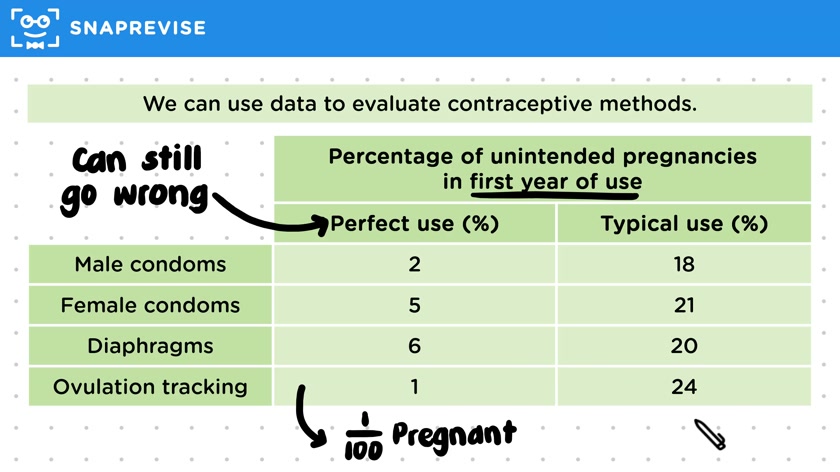
- Effectiveness of contraception can be evaluated using data such as the percentage of unintended pregnancies in the first year of use.
- No contraceptive method is 100% effective.
- Examples of non-hormonal contraception include male condoms, female condoms, diaphragms, and ovulation tracking.
- Ovulation tracking involves avoiding intercourse during fertile periods but has a higher rate of unintended pregnancies with typical use compared to perfect use.
- Male condoms are more effective than ovulation tracking in typical use scenarios.
- Qualitative data, which is language-based and descriptive, can be used to evaluate the pros and cons of different contraceptive methods.
- Oral contraceptives and contraceptive implants both reduce heavy periods and have potential side effects like headaches, nausea, breast tenderness, and mood changes.
- Oral contraceptives can reduce the risk of certain cancers and acne but may cause spotting between periods and increase blood pressure.
- Contraceptive implants are suitable for those who cannot use estrogen-based contraception and last for three years but require a procedure for fitting and removal and can cause acne.
- There is no evidence that oral contraceptives cause weight gain.
- Understanding the pros and cons of various contraceptive methods can be important for making informed decisions and may be relevant in academic assessments.
Please subscribe to access these revision notes.
This, and all other video notes, are included in our premium subscriptions.
Premium accounts get access to all videos and revision notes.
162
questions for Homeostasis and response
99
questions for Hormonal coordination in humans