
GCSE Biology (AQA)
331 videos | 14 hours
Please subscribe to watch this video.
This, and all other videos, are included in our premium subscriptions.
Premium accounts get access to all videos.
Enable autoplay to keep watching
Your browser is blocking videos from playing automatically. To turn it back on:
Safari (Mac): Click the Safari menu item in the top bar, then Settings → Websites → Auto-Play, then set Auto-Play to Allow All Auto-Play for the current website.
Safari (iPhone/iPad): open the Settings app, then Apps → Safari → Auto-Play, and select Allow All Auto-Play.
Evolution of Antibiotic Resistance
- Bacteria reproduce quickly, allowing for rapid evolution.
- Evolution in bacteria occurs due to the fast generation of new bacteria.
- Bacteria can evolve to adapt to different food sources, movement methods, toxicity levels, and develop antibiotic resistance.
- Antibiotic resistance is a key example of bacterial evolution, especially relevant for exams.
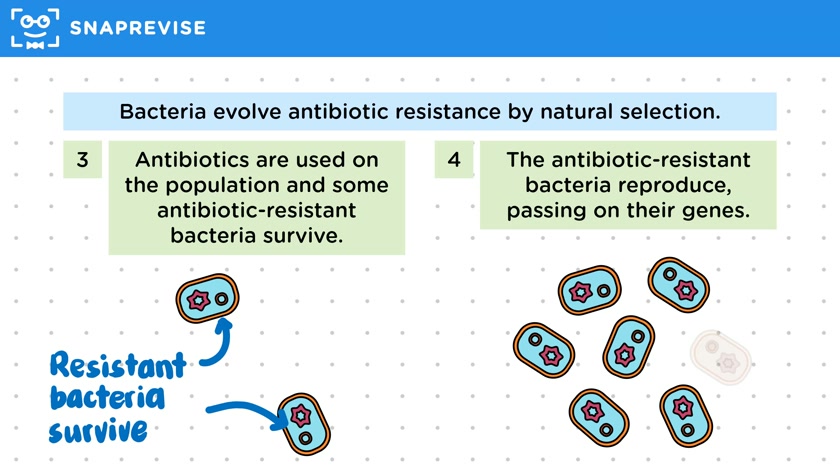
- Bacteria become antibiotic-resistant through natural selection.
- Mutations in some bacteria give them resistance to antibiotics, creating new strains.
- When antibiotics are used, resistant bacteria survive and reproduce, passing on their resistance genes.
- The resistant bacterial population increases as non-resistant strains are eliminated by antibiotics.
- MRSA (Methicillin-resistant Staphylococcus aureus) is an example of a bacterium that has evolved antibiotic resistance through natural selection.
- MRSA is resistant to multiple antibiotics and is a significant concern in hospitals where antibiotics are frequently used.
- Penicillin, the first antibiotic, was derived from mold, a type of fungus.
- For exams, it's important to understand and describe how bacterial antibiotic resistance is an example of evolution through natural selection.
Please subscribe to access these revision notes.
This, and all other video notes, are included in our premium subscriptions.
Premium accounts get access to all videos and revision notes.
114
questions for Inheritance, variation and evolution
47
questions for The development of understanding of genetics and evolution