
GCSE Biology (AQA)
331 videos | 14 hours
Please subscribe to watch this video.
This, and all other videos, are included in our premium subscriptions.
Premium accounts get access to all videos.
Enable autoplay to keep watching
Your browser is blocking videos from playing automatically. To turn it back on:
Safari (Mac): Click the Safari menu item in the top bar, then Settings → Websites → Auto-Play, then set Auto-Play to Allow All Auto-Play for the current website.
Safari (iPhone/iPad): open the Settings app, then Apps → Safari → Auto-Play, and select Allow All Auto-Play.
Eye Structure
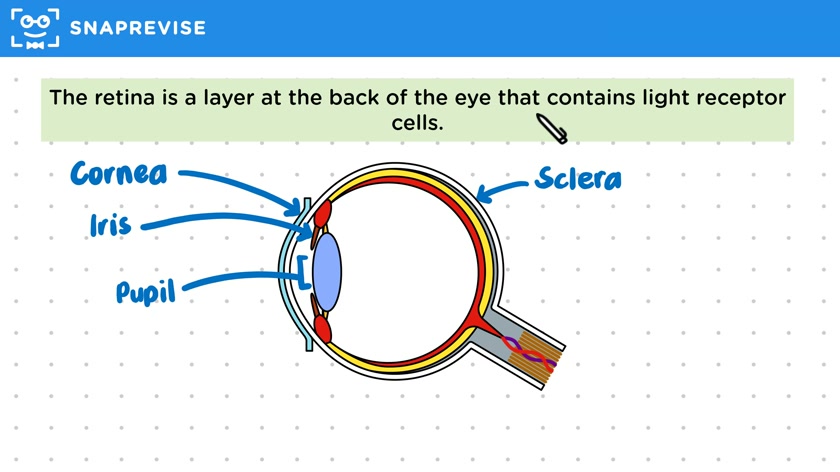
- The eye is a sense organ composed of various parts that work together to bend, focus, and sense light, allowing the brain to perceive light, intensity, and color.
- The sclera, the white outer layer of the eyeball, functions to protect and support the eye.
- The cornea, a transparent outer layer at the front of the eye, refracts (bends) light into the eye.
- The iris, the colored part of the eye, contains muscles that control the amount of light entering the eye through the pupil, which appears black because it is a hole allowing light in.
- The retina, located at the back of the eye, contains light receptor cells that detect different kinds of light, including low intensity and various colors or wavelengths.
- The lens, a nearly transparent structure behind the iris, focuses light towards the retina.
- The lens's shape and position are controlled by the ciliary muscles and suspensory ligaments, which contract and relax (muscles) and tighten and loosen (ligaments) to adjust the lens.
- The optic nerve, a bundle of neurons at the back of the eye, carries impulses from the retina's receptors to the brain, highlighting the interdependence of the eyes and brain for vision.
Please subscribe to access these revision notes.
This, and all other video notes, are included in our premium subscriptions.
Premium accounts get access to all videos and revision notes.
162
questions for Homeostasis and response
51
questions for The human nervous system