
GCSE Biology (AQA)
331 videos | 14 hours
Please subscribe to watch this video.
This, and all other videos, are included in our premium subscriptions.
Premium accounts get access to all videos.
Enable autoplay to keep watching
Your browser is blocking videos from playing automatically. To turn it back on:
Safari (Mac): Click the Safari menu item in the top bar, then Settings → Websites → Auto-Play, then set Auto-Play to Allow All Auto-Play for the current website.
Safari (iPhone/iPad): open the Settings app, then Apps → Safari → Auto-Play, and select Allow All Auto-Play.
Filtration & Selective Reabsorption
- The kidney function is likened to cleaning out a bag, removing all contents initially and then selectively returning what is needed.
- Kidneys filter the blood, removing most substances initially, then reabsorbing necessary substances back into the blood.
- Waste products, represented by a paper airplane in the analogy, are excreted by the kidneys.
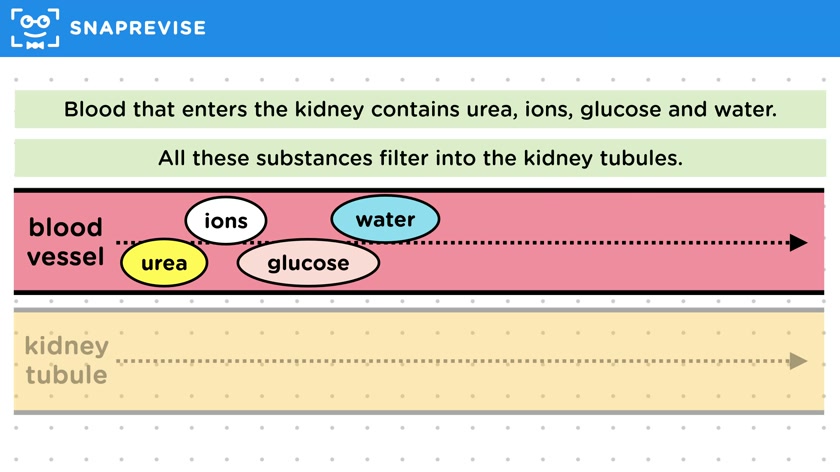
- Blood flows through many small vessels in the kidney, running alongside tiny tubes called tubules.
- Filtration is the movement of substances from the blood into the kidney tubules.
- Selective reabsorption is the process where specific substances are absorbed back into the blood from the tubules.
- Blood entering the kidney contains urea, ions, glucose, and water, all of which filter into the kidney tubules.
- All glucose is reabsorbed back into the blood, while some ions and water are also reabsorbed; excess ions and water remain in the tubules.
- Urea, excess ions, and excess water in the tubules form urine.
- The composition of blood entering and exiting the kidney and the urine is summarized: glucose is reabsorbed for respiration, urea is excreted as it's useless to the body, ions and water are found in reduced levels in the blood exiting the kidney, with excess being excreted in urine.
Please subscribe to access these revision notes.
This, and all other video notes, are included in our premium subscriptions.
Premium accounts get access to all videos and revision notes.
162
questions for Homeostasis and response
99
questions for Hormonal coordination in humans