
GCSE Biology (AQA)
331 videos | 14 hours
Please subscribe to watch this video.
This, and all other videos, are included in our premium subscriptions.
Premium accounts get access to all videos.
Enable autoplay to keep watching
Your browser is blocking videos from playing automatically. To turn it back on:
Safari (Mac): Click the Safari menu item in the top bar, then Settings → Websites → Auto-Play, then set Auto-Play to Allow All Auto-Play for the current website.
Safari (iPhone/iPad): open the Settings app, then Apps → Safari → Auto-Play, and select Allow All Auto-Play.
Genetic Engineering Process
- Genetic engineering involves multiple steps, starting with selecting a cell containing a desired gene.
- The process typically uses a human cell and a bacterium to transfer the gene.
- Desired genes can come from various sources including plant cells, animal cells, or microorganisms.
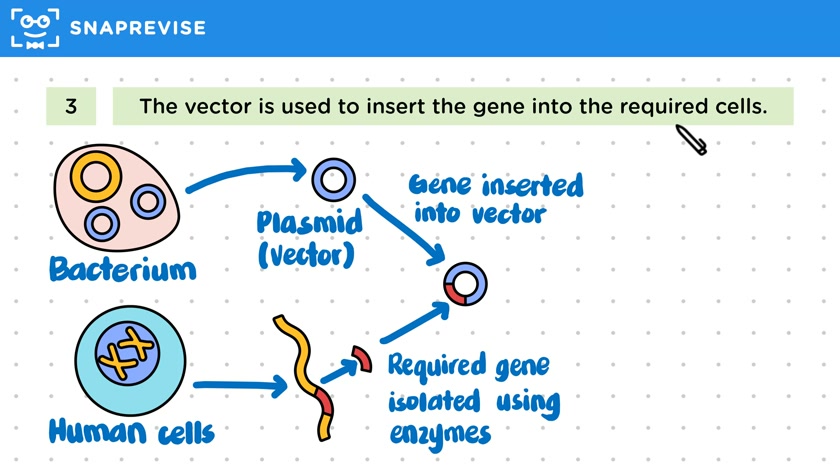
- Step one involves using enzymes to isolate the required gene from the chromosome.
- In step two, the isolated gene is inserted into a vector, usually a plasmid or virus.
- A plasmid, a circular loop of DNA, acts as the vector carrying the desired gene.
- Step three involves using the vector to insert the gene into the required cells, which could be bacterial, animal, plant, or microorganism cells.
- The modified cell reproduces to create more cells containing the desired gene.
- Genes are added at an early stage of cell development to ensure all cells in the organism have the desired characteristics.
- For example, modifying a plant cell early to be disease-resistant ensures all cells in the grown plant have this trait.
- Modifying a cell in a mature plant would only affect a section of the plant, not the whole.
- Understanding the purpose of early-stage gene addition is crucial for exams, as it ensures the entire organism develops with the desired characteristics.
Please subscribe to access these revision notes.
This, and all other video notes, are included in our premium subscriptions.
Premium accounts get access to all videos and revision notes.
114
questions for Inheritance, variation and evolution
47
questions for Variation and evolution