
GCSE Biology (AQA)
331 videos | 14 hours
Please subscribe to watch this video.
This, and all other videos, are included in our premium subscriptions.
Premium accounts get access to all videos.
Enable autoplay to keep watching
Your browser is blocking videos from playing automatically. To turn it back on:
Safari (Mac): Click the Safari menu item in the top bar, then Settings → Websites → Auto-Play, then set Auto-Play to Allow All Auto-Play for the current website.
Safari (iPhone/iPad): open the Settings app, then Apps → Safari → Auto-Play, and select Allow All Auto-Play.
Investigating Transpiration Rate
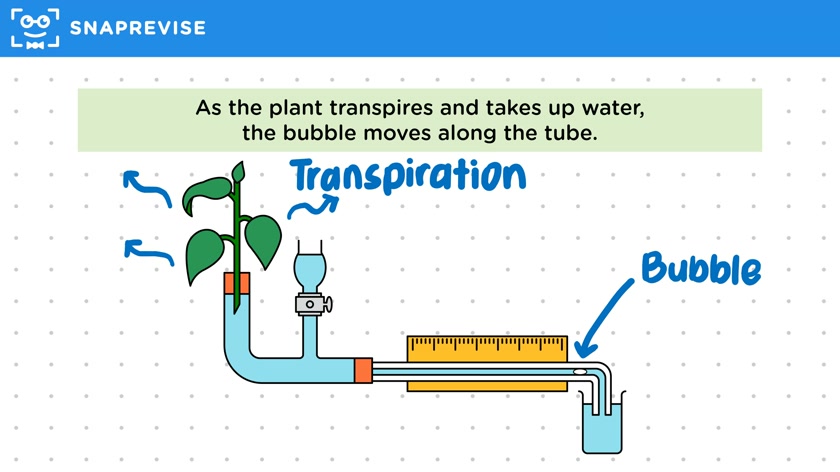
- Transpiration rate in plants can be investigated using a barometer.
- A barometer setup includes a plant chute inserted through a rubber bung into water, with water represented in blue in the diagram.
- The apparatus features a reservoir, a scale (yellow section), and a tube with an air bubble.
- The tube extends into a beaker of water.
- As the plant transpires and takes up water, the air bubble in the tube moves along the scale.
- Transpiration involves water evaporation from leaf surfaces, which pulls water up the glass tube, moving the bubble along the scale.
- Transpiration rates can be determined by recording the movement of the bubble over a known period of time.
- The position of the bubble is recorded at regular intervals under different conditions and with different plants.
- Factors that can increase the rate of transpiration include light intensity, temperature, airflow, and humidity.
- Investigations can also explore how Stata distribution affects transpiration rates.
Please subscribe to access these revision notes.
This, and all other video notes, are included in our premium subscriptions.
Premium accounts get access to all videos and revision notes.
55
questions for Organisation
4
questions for Plant tissues, organs and systems