
GCSE Biology (AQA)
331 videos | 14 hours
Please subscribe to watch this video.
This, and all other videos, are included in our premium subscriptions.
Premium accounts get access to all videos.
Enable autoplay to keep watching
Your browser is blocking videos from playing automatically. To turn it back on:
Safari (Mac): Click the Safari menu item in the top bar, then Settings → Websites → Auto-Play, then set Auto-Play to Allow All Auto-Play for the current website.
Safari (iPhone/iPad): open the Settings app, then Apps → Safari → Auto-Play, and select Allow All Auto-Play.
Kidney Dialysis
- Kidney dialysis is a treatment for people with kidney failure.
- Dialysis is typically performed using a dialysis machine, although peritoneal dialysis is an exception.
- A dialysis machine functions as an artificial kidney and is connected to the patient via tubes.
- Blood is pumped into and out of the machine through these tubes.
- The machine mimics kidney function by using a membrane to filter waste products from the blood into dialysis fluid.
- The used dialysis fluid is then disposed of, and the filtered blood is returned to the patient's body.
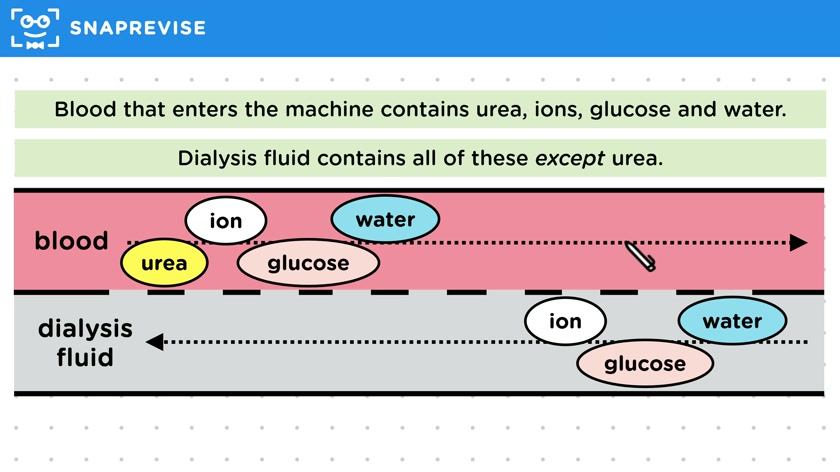
- Dialysis fluid and blood flow in opposite directions within the machine, facilitating the diffusion of substances.
- Blood entering the machine contains urea, glucose, and water, while dialysis fluid contains similar concentrations of ions and glucose but no urea.
- Urea diffuses from the blood (high concentration) into the dialysis fluid (low concentration) and is then disposed of.
- The dialysis fluid is designed to match the ideal concentration of blood plasma, ensuring no net movement of ions if their concentrations are equal in both fluids.
- If a patient's blood ion levels are too high, excess ions diffuse into the dialysis fluid, lowering the blood ion levels to ideal.
- Conversely, if blood ion levels are too low, ions from the dialysis fluid diffuse into the blood to restore ideal levels.
- This process also helps maintain healthy glucose levels in the blood during dialysis.
Please subscribe to access these revision notes.
This, and all other video notes, are included in our premium subscriptions.
Premium accounts get access to all videos and revision notes.
162
questions for Homeostasis and response
99
questions for Hormonal coordination in humans