
GCSE Biology (AQA)
331 videos | 14 hours
Please subscribe to watch this video.
This, and all other videos, are included in our premium subscriptions.
Premium accounts get access to all videos.
Enable autoplay to keep watching
Your browser is blocking videos from playing automatically. To turn it back on:
Safari (Mac): Click the Safari menu item in the top bar, then Settings → Websites → Auto-Play, then set Auto-Play to Allow All Auto-Play for the current website.
Safari (iPhone/iPad): open the Settings app, then Apps → Safari → Auto-Play, and select Allow All Auto-Play.
Leaves
- Multicellular plants have specialized cells organized into tissues, organs, and organ systems.
- Understanding the organization of multicellular plants and animals is essential, including definitions of cells, tissues, and organs.
- Cells are the basic building blocks, tissues are groups of similar cells, and organs are collections of tissues with specific functions.
- Leaves are plant organs primarily responsible for photosynthesis and controlling water flow.
- Observing leaf tissues requires examining a cross-section under a microscope.
- Leaf tissues include the upper epidermis, palisade mesophyll, spongy mesophyll, and lower epidermis.
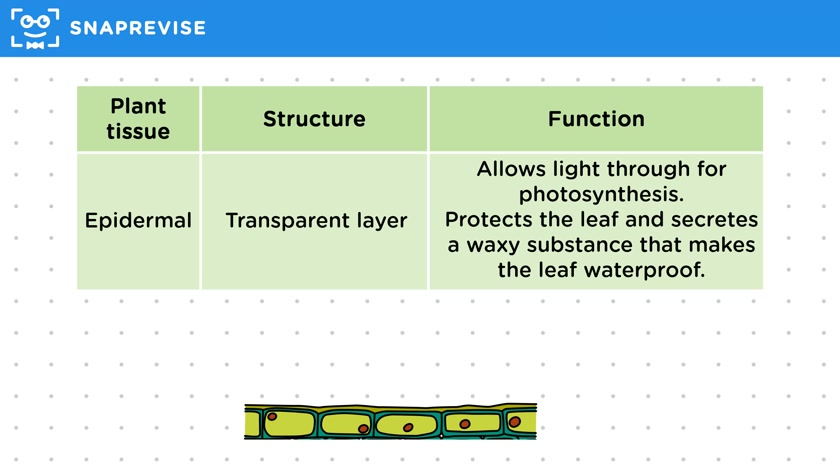
- The upper and lower epidermis contain epidermal tissue, which is transparent to allow light for photosynthesis and protects the leaf with a waxy cuticle.
- The palisade mesophyll is adapted for light absorption and contains chloroplasts for photosynthesis.
- The spongy mesophyll facilitates gas exchange and has a large surface area with air gaps.
- Xylem and phloem form the vascular bundle, transporting water and nutrients within the plant.
- Understanding the structure and function of these tissues is crucial for explaining their roles in plant physiology.
Please subscribe to access these revision notes.
This, and all other video notes, are included in our premium subscriptions.
Premium accounts get access to all videos and revision notes.
55
questions for Organisation
4
questions for Plant tissues, organs and systems