
GCSE Biology (AQA)
331 videos | 14 hours
Please subscribe to watch this video.
This, and all other videos, are included in our premium subscriptions.
Premium accounts get access to all videos.
Enable autoplay to keep watching
Your browser is blocking videos from playing automatically. To turn it back on:
Safari (Mac): Click the Safari menu item in the top bar, then Settings → Websites → Auto-Play, then set Auto-Play to Allow All Auto-Play for the current website.
Safari (iPhone/iPad): open the Settings app, then Apps → Safari → Auto-Play, and select Allow All Auto-Play.
Lowering Blood Glucose Levels
- Blood glucose levels increase after eating due to the breakdown of food which produces glucose.
- Glucose is absorbed into the bloodstream through the small intestine walls and is then carried to body cells.
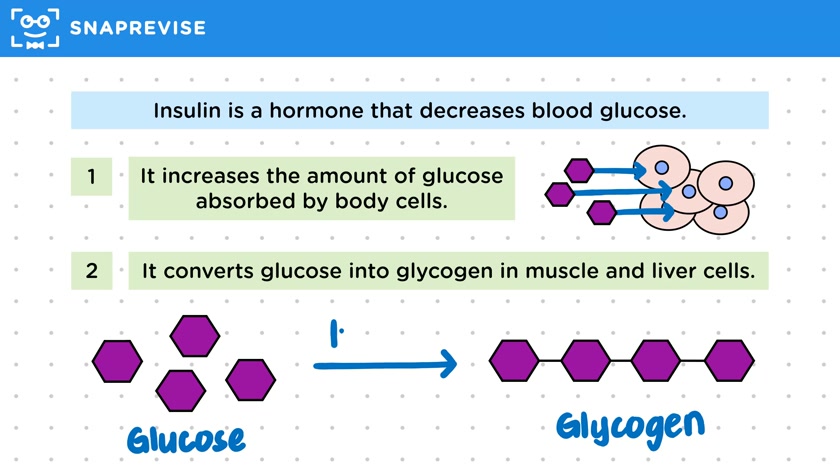
- Insulin, a hormone, helps decrease blood glucose levels.
- Insulin functions by increasing glucose absorption by body cells and converting glucose into glycogen in muscle and liver cells.
- Glucose molecules are represented as purple hexagons, and glycogen is depicted as a chain or polymer of glucose molecules.
- Glycogen serves as a storage form of glucose for later use, especially when blood glucose levels drop after not eating for a while.
- The pancreas plays a crucial role in regulating blood glucose by detecting increases in glucose levels and releasing insulin.
- This release of insulin leads to glucose uptake by body cells and conversion of glucose to glycogen in muscle and liver cells, ultimately lowering blood sugar.
- The regulation of blood glucose is an example of homeostasis, a process that maintains stability in the body.
Please subscribe to access these revision notes.
This, and all other video notes, are included in our premium subscriptions.
Premium accounts get access to all videos and revision notes.
162
questions for Homeostasis and response
99
questions for Hormonal coordination in humans