
GCSE Biology (AQA)
331 videos | 14 hours
Please subscribe to watch this video.
This, and all other videos, are included in our premium subscriptions.
Premium accounts get access to all videos.
Enable autoplay to keep watching
Your browser is blocking videos from playing automatically. To turn it back on:
Safari (Mac): Click the Safari menu item in the top bar, then Settings → Websites → Auto-Play, then set Auto-Play to Allow All Auto-Play for the current website.
Safari (iPhone/iPad): open the Settings app, then Apps → Safari → Auto-Play, and select Allow All Auto-Play.
Mean, Median & Mode
- Mean, median, and mode are essential mathematical terms for interpreting results in biology.
- These terms help understand quantitative data from samples or populations.
- Mean is calculated by dividing the sum of data values by the number of data values.
- Mean can only be calculated for quantitative data, not for categories or names.
- Example provided: Mean of values 3, 5, 4, 4 is 4.
- In ecology, mean percentage grass coverage on a field is calculated using data from a table.
- Steps to calculate mean: read the question, count data values, find the sum of data values, divide the sum by the number of data values.
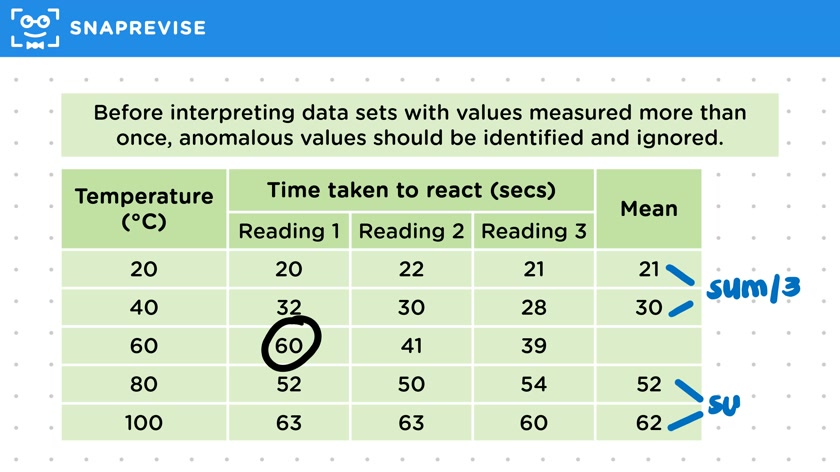
- Anomalous values in repeated results should be identified and ignored.
- Median is the middle value when data is arranged in numerical order.
- Mode is the most frequently occurring value in a dataset.
- Mode can be used for both qualitative and quantitative data.
- Statistical diagrams like pie charts and pictograms help easily identify the mode.
- In frequency tables, the mode is the data value with the greatest frequency.
Please subscribe to access these revision notes.
This, and all other video notes, are included in our premium subscriptions.
Premium accounts get access to all videos and revision notes.
61
questions for Ecology
16
questions for Organisation of an ecosystem