
GCSE Biology (AQA)
331 videos | 14 hours
Please subscribe to watch this video.
This, and all other videos, are included in our premium subscriptions.
Premium accounts get access to all videos.
Enable autoplay to keep watching
Your browser is blocking videos from playing automatically. To turn it back on:
Safari (Mac): Click the Safari menu item in the top bar, then Settings → Websites → Auto-Play, then set Auto-Play to Allow All Auto-Play for the current website.
Safari (iPhone/iPad): open the Settings app, then Apps → Safari → Auto-Play, and select Allow All Auto-Play.
Mutations
- Mutations cause changes in DNA structure.
- Mutations can change the phenotype, though rarely.
- An example of a phenotype-changing mutation is heterochromia, which results in two different eye colors.
- Mutations occur naturally and can be triggered by radiation or toxic substances.
- Common sources of such mutations include gamma rays, x-rays, UV rays, and toxic substances in cigarette smoke.
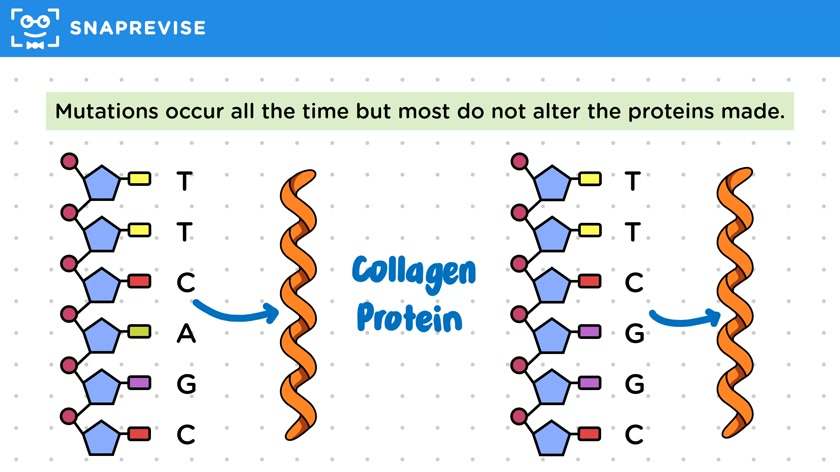
- Mutations affect the sequence of bases in DNA, altering the genetic code.
- Most mutations do not change the proteins produced by DNA.
- Serious mutations, like base insertions or deletions, can alter the entire amino acid sequence of a protein.
- Changes in the amino acid sequence can lead to proteins with different shapes and functions.
- This can affect the strength of structural proteins like collagen or the activity of enzymes by altering their active sites.
- Mutations are sometimes referred to as genetic variants because they can result in different proteins being produced.
Please subscribe to access these revision notes.
This, and all other video notes, are included in our premium subscriptions.
Premium accounts get access to all videos and revision notes.
114
questions for Inheritance, variation and evolution
19
questions for Reproduction