
GCSE Biology (AQA)
331 videos | 14 hours
Please subscribe to watch this video.
This, and all other videos, are included in our premium subscriptions.
Premium accounts get access to all videos.
Enable autoplay to keep watching
Your browser is blocking videos from playing automatically. To turn it back on:
Safari (Mac): Click the Safari menu item in the top bar, then Settings → Websites → Auto-Play, then set Auto-Play to Allow All Auto-Play for the current website.
Safari (iPhone/iPad): open the Settings app, then Apps → Safari → Auto-Play, and select Allow All Auto-Play.
Myopia & Hyperopia
- Two common eye defects are shortsightedness (myopia) and longsightedness (hyperopia).
- In myopia, objects near the eye are clear, while distant objects appear blurry.
- In hyperopia, close objects appear blurry, while distant objects are clearer.
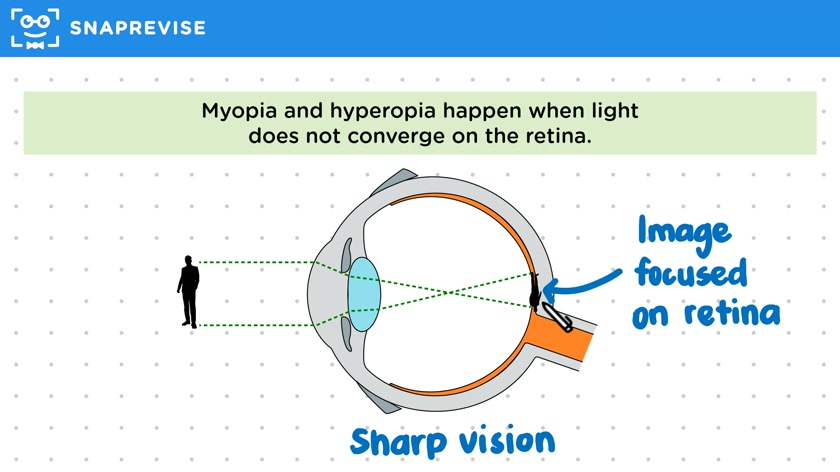
- Both conditions occur when light does not focus correctly on the retina.
- Sharp vision requires light to be perfectly focused on the retina.
- The brain flips the image received on the retina to correct the orientation for our vision.
- In myopia, light is over-refracted, causing images to focus in front of the retina.
- In hyperopia, there is insufficient refraction, causing images to focus behind the retina.
- Causes of these conditions include variations in the length of the eye or the thickness of the lens or cornea.
Please subscribe to access these revision notes.
This, and all other video notes, are included in our premium subscriptions.
Premium accounts get access to all videos and revision notes.
162
questions for Homeostasis and response
51
questions for The human nervous system