
GCSE Biology (AQA)
331 videos | 14 hours
Please subscribe to watch this video.
This, and all other videos, are included in our premium subscriptions.
Premium accounts get access to all videos.
Enable autoplay to keep watching
Your browser is blocking videos from playing automatically. To turn it back on:
Safari (Mac): Click the Safari menu item in the top bar, then Settings → Websites → Auto-Play, then set Auto-Play to Allow All Auto-Play for the current website.
Safari (iPhone/iPad): open the Settings app, then Apps → Safari → Auto-Play, and select Allow All Auto-Play.
Photosynthesis
- Plants perform photosynthesis to create their own food in the form of glucose.
- Chloroplasts in plant cells contain chlorophyll which captures light energy.
- Light energy is used in chloroplasts to drive a chemical reaction that produces sugar.
- Photosynthesis is an endothermic reaction, meaning it requires energy from the environment, specifically light.
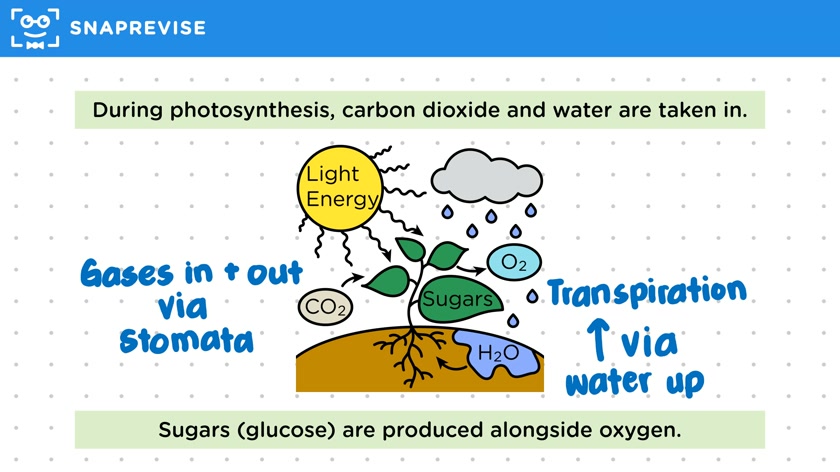
- The reactants of photosynthesis are carbon dioxide and water, which are taken in through the leaves and roots respectively.
- The products of photosynthesis are glucose (sugar) and oxygen, with oxygen being released as a waste product.
- Gases move in and out of leaves via stomata using diffusion, and water is transported up the plant through transpiration.
- Essential factors for photosynthesis include carbon dioxide, water, warmth, and light energy.
- The word equation for photosynthesis is: Carbon dioxide + water + light energy ��� glucose + oxygen.
- The symbol equation for photosynthesis is represented with chemical symbols and shows the stoichiometry of the reactants and products.
- It's important to recognize and recall the chemical symbols for carbon dioxide (CO2), water (H2O), glucose (C6H12O6), and oxygen (O2) for academic purposes.
Please subscribe to access these revision notes.
This, and all other video notes, are included in our premium subscriptions.
Premium accounts get access to all videos and revision notes.
50
questions for Bioenergetics
29
questions for Photosynthesis