
GCSE Biology (AQA)
331 videos | 14 hours
Please subscribe to watch this video.
This, and all other videos, are included in our premium subscriptions.
Premium accounts get access to all videos.
Enable autoplay to keep watching
Your browser is blocking videos from playing automatically. To turn it back on:
Safari (Mac): Click the Safari menu item in the top bar, then Settings → Websites → Auto-Play, then set Auto-Play to Allow All Auto-Play for the current website.
Safari (iPhone/iPad): open the Settings app, then Apps → Safari → Auto-Play, and select Allow All Auto-Play.
Population Size in Standard Form
- Bacteria reproduce quickly, leading to large populations.
- Bacterial population sizes are often expressed in standard form.
- A Petri dish is used to show bacterial growth.
- To calculate the size of a bacterial population, consider the mean division time.
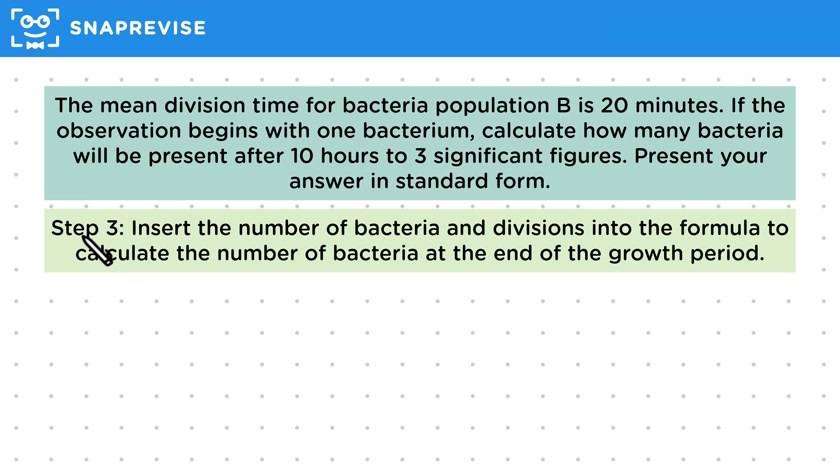
- For example, if population B has a mean division time of 20 minutes:
- Calculate how many times bacteria divide in an hour (60 minutes / 20 minutes = 3 divisions per hour).
- For a 10-hour period, bacteria would divide 30 times (3 divisions/hour * 10 hours).
- Use the formula: final number of bacteria = initial number of bacteria * 2^(number of divisions).
- If starting with one bacterium, after 30 divisions, the population size is 1 * 2^30.
- Present large numbers in standard form by identifying three significant figures and adjusting the exponent.
- Example: Convert a large number to 1.07 * 10^9 to express it in standard form.
- Calculators can automatically convert large whole numbers into standard form.
Please subscribe to access these revision notes.
This, and all other video notes, are included in our premium subscriptions.
Premium accounts get access to all videos and revision notes.
145
questions for Cell biology
27
questions for Cell structure