
GCSE Biology (AQA)
331 videos | 14 hours
Please subscribe to watch this video.
This, and all other videos, are included in our premium subscriptions.
Premium accounts get access to all videos.
Enable autoplay to keep watching
Your browser is blocking videos from playing automatically. To turn it back on:
Safari (Mac): Click the Safari menu item in the top bar, then Settings → Websites → Auto-Play, then set Auto-Play to Allow All Auto-Play for the current website.
Safari (iPhone/iPad): open the Settings app, then Apps → Safari → Auto-Play, and select Allow All Auto-Play.
Protein Synthesis
- Protein synthesis is the formation of proteins, which are made up of amino acids.
- Proteins have multiple uses in the body, including forming enzymes, structural components in muscles and tissues, carrier molecules like active transport pumps, and hormones.
- Proteins do not last forever, leading cells to almost continuously carry out protein synthesis.
- Protein synthesis occurs on ribosomes, which are distributed throughout the cytoplasm.
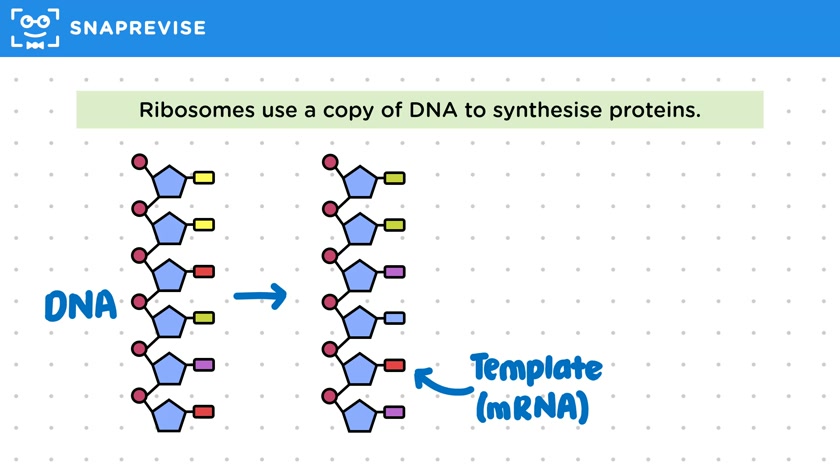
- Ribosomes use a copy of DNA to synthesize proteins; this copy is called mRNA, which acts as a template and leaves the nucleus to reach the ribosome.
- Carrier molecules, referred to as tRNA, bring specific amino acids to the ribosome according to the mRNA template.
- As the ribosome moves along the mRNA template, amino acids are added, and the protein chain grows.
- After the amino acid sequence is completed, the protein chain folds into a unique shape, enabling it to function as enzymes, hormones, or structural components like muscle or collagen.
- Detailed knowledge of the structure of mRNA, tRNA, amino acids, or proteins is not required for exams.
Please subscribe to access these revision notes.
This, and all other video notes, are included in our premium subscriptions.
Premium accounts get access to all videos and revision notes.
114
questions for Inheritance, variation and evolution
19
questions for Reproduction