
GCSE Biology (AQA)
331 videos | 14 hours
Please subscribe to watch this video.
This, and all other videos, are included in our premium subscriptions.
Premium accounts get access to all videos.
Enable autoplay to keep watching
Your browser is blocking videos from playing automatically. To turn it back on:
Safari (Mac): Click the Safari menu item in the top bar, then Settings → Websites → Auto-Play, then set Auto-Play to Allow All Auto-Play for the current website.
Safari (iPhone/iPad): open the Settings app, then Apps → Safari → Auto-Play, and select Allow All Auto-Play.
Pyramids of Biomass
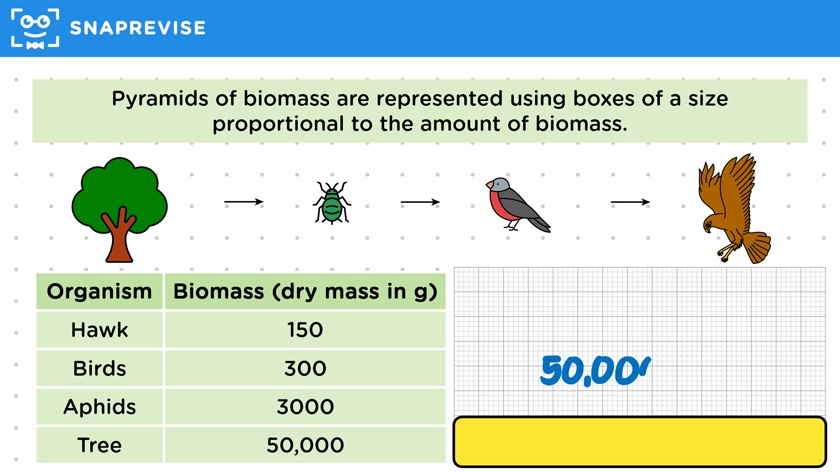
- Pyramids of biomass represent the relative amount of biomass at each level of a food chain.
- Biomass refers to the total mass of organisms in a given area or volume and is considered as dry mass.
- A food chain example is used to illustrate the construction of a pyramid of biomass.
- Biomass decreases from the producer level (tree) to the top predator (hawk) in the food chain.
- The pyramid of biomass is constructed by placing the lowest trophic level (producers) at the bottom.
- Producers in the example are photosynthetic organisms, specifically a tree.
- Boxes proportional to the biomass amount are used to represent each trophic level on graph paper.
- The boxes are drawn to scale, with the tree represented by a large box and the hawk by a very small box.
- Boxes for each trophic level (tree, aphids, birds, hawk) are stacked centrally on top of each other.
- Each box is labeled according to the organism it represents.
- When drawing a pyramid of biomass by hand, a central line can be drawn on graph paper to help measure and place each box symmetrically.
- The height of all boxes should be the same, and they should be labeled correctly.
- Any guide lines used during the drawing process should be erased for clarity.
Please subscribe to access these revision notes.
This, and all other video notes, are included in our premium subscriptions.
Premium accounts get access to all videos and revision notes.
61
questions for Ecology
15
questions for Trophic levels in an ecosystem (biology only)