
GCSE Biology (AQA)
331 videos | 14 hours
Please subscribe to watch this video.
This, and all other videos, are included in our premium subscriptions.
Premium accounts get access to all videos.
Enable autoplay to keep watching
Your browser is blocking videos from playing automatically. To turn it back on:
Safari (Mac): Click the Safari menu item in the top bar, then Settings → Websites → Auto-Play, then set Auto-Play to Allow All Auto-Play for the current website.
Safari (iPhone/iPad): open the Settings app, then Apps → Safari → Auto-Play, and select Allow All Auto-Play.
Quadrats & Transects
- Quadrats and transects are tools used to sample ecosystems and study the distribution and abundance of organisms.
- Distribution refers to the location of organisms, such as grass being less abundant under trees.
- Abundance indicates the number of individuals per species, like the number of grass plants in an area.
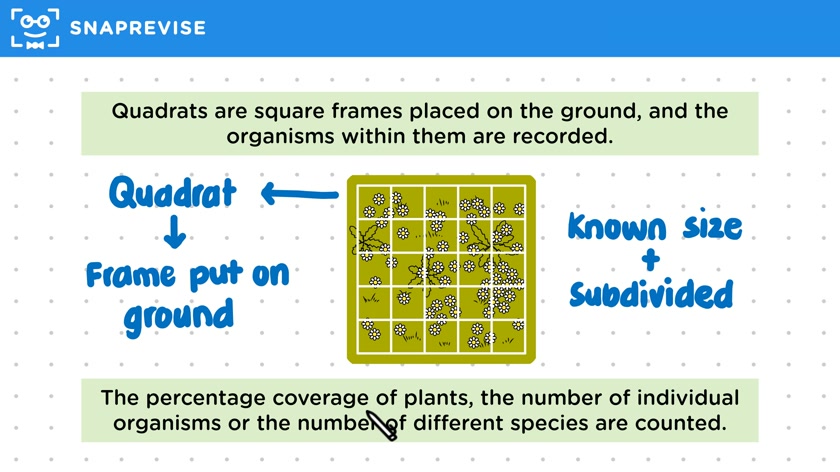
- A quadrat is a square frame placed on the ground to record organisms within its boundaries, often subdivided into smaller sections for detailed analysis.
- The size of a quadrat can vary, commonly being 25 centimeters squared.
- Quadrats help in counting the percentage coverage of plants, the number of individual organisms, or the number of different species.
- Placement of quadrats can be random, determined by using tape measures at right angles and a random number generator to select coordinates.
- At least 10 samples are usually taken to ensure random sampling and reduce bias.
- A transect involves placing quadrats at regular intervals along a line to systematically sample and observe changes in distribution or abundance across a specific area, like a pathway or shoreline.
- This method of using a transect is systematic and not random.
Please subscribe to access these revision notes.
This, and all other video notes, are included in our premium subscriptions.
Premium accounts get access to all videos and revision notes.
61
questions for Ecology
16
questions for Organisation of an ecosystem