
GCSE Biology (AQA)
331 videos | 14 hours
Please subscribe to watch this video.
This, and all other videos, are included in our premium subscriptions.
Premium accounts get access to all videos.
Enable autoplay to keep watching
Your browser is blocking videos from playing automatically. To turn it back on:
Safari (Mac): Click the Safari menu item in the top bar, then Settings → Websites → Auto-Play, then set Auto-Play to Allow All Auto-Play for the current website.
Safari (iPhone/iPad): open the Settings app, then Apps → Safari → Auto-Play, and select Allow All Auto-Play.
Single-Celled Organisms
- Single-celled organisms have a large surface area to volume ratio.
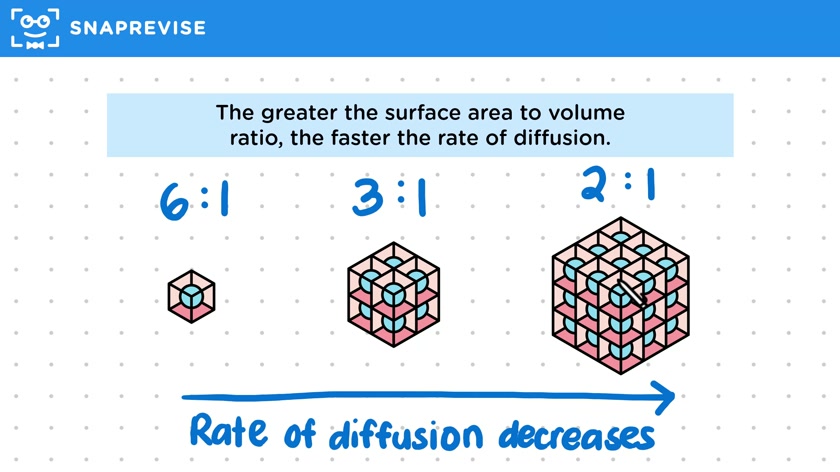
- A diagram illustrates a single-celled organism with a 6:1 surface area to volume ratio.
- Multicellular organisms have lower surface area to volume ratios, examples given are 3:1 and 2:1.
- As organisms increase in cell number (from single-celled to multicellular), the surface area to volume ratio decreases.
- A higher surface area to volume ratio facilitates a faster rate of diffusion.
- The rate of diffusion decreases as the surface area to volume ratio decreases from single-celled to multicellular organisms.
- For exams, it's important to know that single-celled organisms have a relatively large surface area to volume ratio.
- The large surface area to volume ratio in single-celled organisms is crucial for efficient diffusion.
- Single-celled organisms rely on diffusion for the intake of oxygen and the expulsion of carbon dioxide.
- The large surface area to volume ratio allows for adequate transport of molecules to meet the cell's metabolic needs.
- Fast diffusion is necessary to sustain the metabolic demands of the cell and to eliminate waste products.
Please subscribe to access these revision notes.
This, and all other video notes, are included in our premium subscriptions.
Premium accounts get access to all videos and revision notes.
145
questions for Cell biology
64
questions for Transport in cells