
GCSE Biology (AQA)
331 videos | 14 hours
Please subscribe to watch this video.
This, and all other videos, are included in our premium subscriptions.
Premium accounts get access to all videos.
Enable autoplay to keep watching
Your browser is blocking videos from playing automatically. To turn it back on:
Safari (Mac): Click the Safari menu item in the top bar, then Settings → Websites → Auto-Play, then set Auto-Play to Allow All Auto-Play for the current website.
Safari (iPhone/iPad): open the Settings app, then Apps → Safari → Auto-Play, and select Allow All Auto-Play.
Stable Communities
- A stable community balances all species and environmental factors with fairly consistent population sizes.
- Populations of different organisms in a stable community vary slightly but remain within a certain range.
- Stability in communities is due to interdependence among species, maintaining balance.
- Organisms depend on each other for resources, leading to population adjustments among species that help maintain balance.
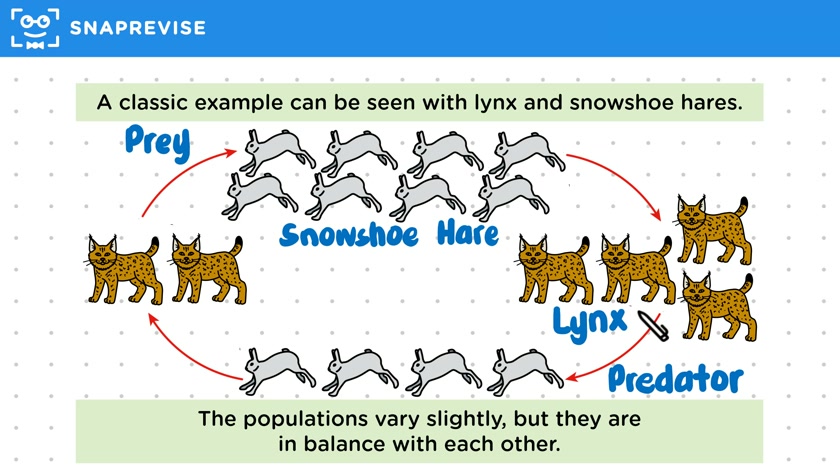
- Example of lynx and snowshoe hares illustrates predator-prey interactions where population sizes of both fluctuate in response to each other.
- As prey (snowshoe hares) population increases, predator (lynx) population also rises due to more available food.
- Increased predators lead to a decrease in prey, which subsequently causes a decrease in predator numbers as food becomes scarce.
- This reduction in predators allows prey population to increase, continuing the cycle.
- Data from 1845 to 1935 shows typical predator-prey cycles, with prey and predator numbers in thousands, demonstrating how predator numbers lag slightly behind prey numbers and fluctuate accordingly.
- The cycle of predator and prey populations is continuous, with increases in predators leading to decreases in prey, and vice versa, maintaining ecological balance.
Please subscribe to access these revision notes.
This, and all other video notes, are included in our premium subscriptions.
Premium accounts get access to all videos and revision notes.
61
questions for Ecology
3
questions for Adaptations, interdependence and competition