
GCSE Biology (AQA)
331 videos | 14 hours
Please subscribe to watch this video.
This, and all other videos, are included in our premium subscriptions.
Premium accounts get access to all videos.
Enable autoplay to keep watching
Your browser is blocking videos from playing automatically. To turn it back on:
Safari (Mac): Click the Safari menu item in the top bar, then Settings → Websites → Auto-Play, then set Auto-Play to Allow All Auto-Play for the current website.
Safari (iPhone/iPad): open the Settings app, then Apps → Safari → Auto-Play, and select Allow All Auto-Play.
Standard Form
- Very small or large numbers are challenging to work with and compare.
- Example: Earth's diameter is approximately 13,000 kilometers, while a marble's diameter is about 13 millimeters.
- Standard form helps express numbers that are too large or small for convenient decimal representation.
- Earth's diameter in standard form: 1.3 x 10^4 kilometers; marble's diameter: 1.3 x 10^-5 kilometers.
- Standard form allows for easier mathematical operations like addition, subtraction, or division between vastly different scales.
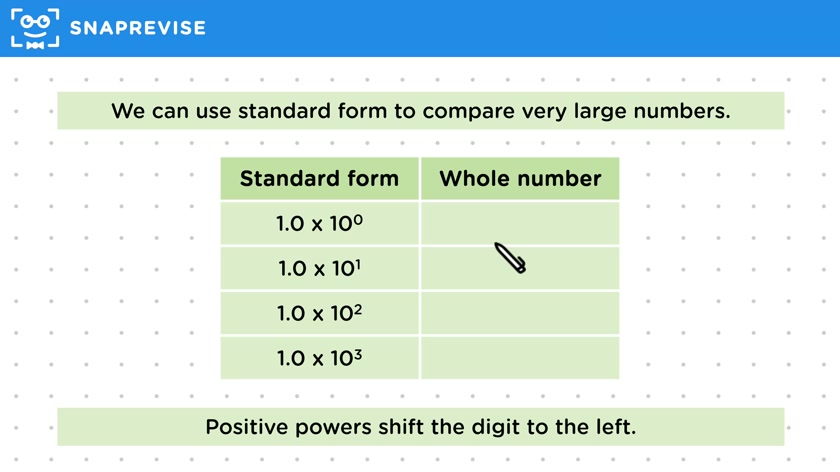
- Standard form is written as a product of a number (between 1 and 10) and a power of 10.
- Significant figures are the digits that provide meaningful contributions to the measurement precision.
- Positive powers of 10 indicate large numbers, shifting the decimal point to the left; negative powers indicate small numbers, shifting it to the right.
- Standard form is essential for scientific calculations and is often required in exams.
- To convert a number to standard form: identify significant figures, place the decimal after the first significant digit, and adjust the power of 10 accordingly.
- Correct units must be included in the final answer when using standard form.
Please subscribe to access these revision notes.
This, and all other video notes, are included in our premium subscriptions.
Premium accounts get access to all videos and revision notes.
145
questions for Cell biology
27
questions for Cell structure