
GCSE Biology (AQA)
331 videos | 14 hours
Please subscribe to watch this video.
This, and all other videos, are included in our premium subscriptions.
Premium accounts get access to all videos.
Enable autoplay to keep watching
Your browser is blocking videos from playing automatically. To turn it back on:
Safari (Mac): Click the Safari menu item in the top bar, then Settings → Websites → Auto-Play, then set Auto-Play to Allow All Auto-Play for the current website.
Safari (iPhone/iPad): open the Settings app, then Apps → Safari → Auto-Play, and select Allow All Auto-Play.
Stem Cells
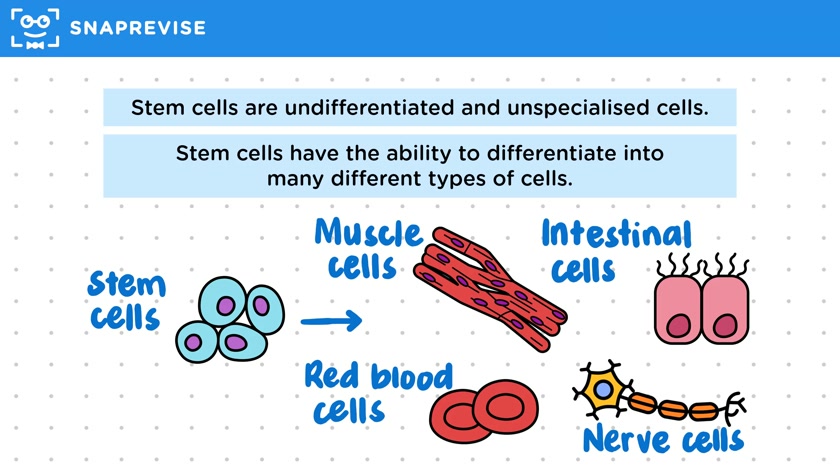
- Stem cells are undifferentiated and unspecialized cells.
- They have the ability to differentiate into many different types of cells.
- Examples include stem cells in muscle tissue becoming muscle cells, neural stem cells differentiating into nerve cells, bone marrow stem cells producing red blood cells, and stem cells in the gut producing intestinal cells.
- The process of differentiation is irreversible; once a stem cell has differentiated, it cannot change back or become another cell type.
- Stem cells can replicate through mitosis, allowing them to self-renew and maintain a pool of stem cells.
- Once a stem cell has specialized, it cannot replicate to produce more stem cells.
- Both animals and plants have stem cells, including adult stem cells and embryonic stem cells in mammals, and meristem cells in plants.
- For exams, understanding the function of stem cells in adult animals, embryos, and meristem cells in plants is essential.
Please subscribe to access these revision notes.
This, and all other video notes, are included in our premium subscriptions.
Premium accounts get access to all videos and revision notes.
145
questions for Cell biology
54
questions for Cell division