
GCSE Biology (AQA)
331 videos | 14 hours
Please subscribe to watch this video.
This, and all other videos, are included in our premium subscriptions.
Premium accounts get access to all videos.
Enable autoplay to keep watching
Your browser is blocking videos from playing automatically. To turn it back on:
Safari (Mac): Click the Safari menu item in the top bar, then Settings → Websites → Auto-Play, then set Auto-Play to Allow All Auto-Play for the current website.
Safari (iPhone/iPad): open the Settings app, then Apps → Safari → Auto-Play, and select Allow All Auto-Play.
Surface Area to Volume Ratio
- The rate of diffusion is influenced by the surface area to volume ratio of a shape.
- Surface area is calculated by measuring the area of each face of a shape, such as a cube.
- Volume is the space inside the shape, for example, how much water can fit inside a cube.
- It's crucial to calculate and compare surface area to volume ratios, especially in exams, and discuss their impact on diffusion.
- To calculate the surface area of a cube: multiply the width by the length by the number of sides.
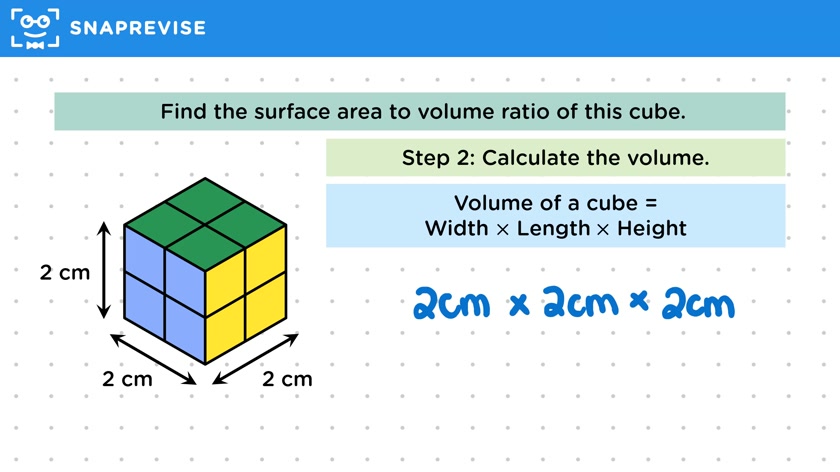
- Example calculation for a cube: width = 2 cm, length = 2 cm, number of sides = 6, resulting in a surface area of 24 cm��.
- Volume of a cube is calculated by multiplying the width by the length by the height.
- Example calculation for volume: 2 cm x 2 cm x 2 cm = 8 cm��.
- Simplify the surface area to volume ratio by dividing both by a common denominator; for example, 24 cm��/8 cm�� simplifies to a ratio of 3:1.
- Ratios do not have units, so units are not included in the simplified ratio.
- A higher surface area to volume ratio increases the rate of diffusion.
- Different size cubes have different surface area to volume ratios, affecting their rates of diffusion.
- Organisms consist of many small cells rather than one large cell to maximize the surface area to volume ratio, enhancing diffusion.
- For exams, understanding the dependency of the rate of diffusion on the surface area to volume ratio is essential, particularly in the context of substance exchange in living organisms.
Please subscribe to access these revision notes.
This, and all other video notes, are included in our premium subscriptions.
Premium accounts get access to all videos and revision notes.
145
questions for Cell biology
64
questions for Transport in cells