
GCSE Biology (AQA)
331 videos | 14 hours
Please subscribe to watch this video.
This, and all other videos, are included in our premium subscriptions.
Premium accounts get access to all videos.
Enable autoplay to keep watching
Your browser is blocking videos from playing automatically. To turn it back on:
Safari (Mac): Click the Safari menu item in the top bar, then Settings → Websites → Auto-Play, then set Auto-Play to Allow All Auto-Play for the current website.
Safari (iPhone/iPad): open the Settings app, then Apps → Safari → Auto-Play, and select Allow All Auto-Play.
Therapeutic Cloning
- Donor stem cells may be rejected by the patient's immune system.
- Patients might need to take immunosuppressants, which weaken the immune system, to prevent rejection.
- Therapeutic cloning creates an embryo with the same genes as the patient, preventing stem cell rejection.
- Embryonic stem cells from therapeutic cloning could be used for medical treatments but are currently only used in research.
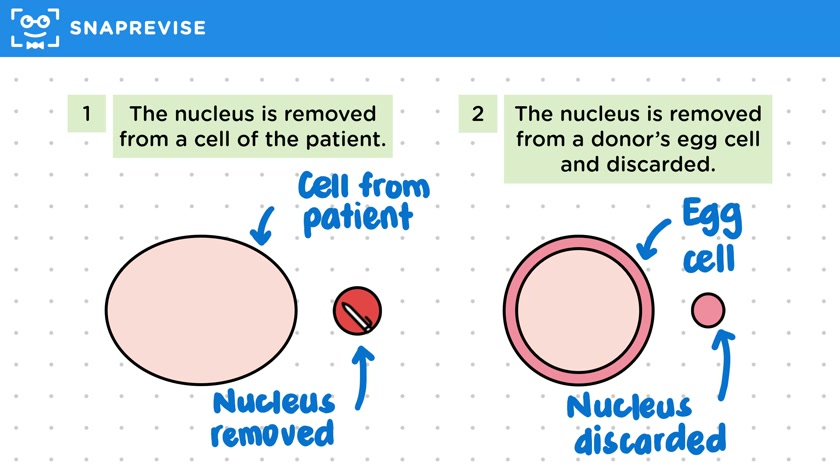
- Therapeutic cloning involves removing the nucleus from a patient's cell (e.g., skin cell) and a donor egg cell.
- The nucleus from the patient's cell is then transferred to the donor egg cell, creating a combined cell.
- This combined cell is stimulated to divide into an embryo using an electric shock.
- The embryo is never fertilized.
- Stem cells are extracted from the embryo, cultured in a Petri dish, and can be made to differentiate into any needed cell type.
- Potential applications include creating pancreatic cells for diabetes treatment or nerve cells for treating paralysis.
Please subscribe to access these revision notes.
This, and all other video notes, are included in our premium subscriptions.
Premium accounts get access to all videos and revision notes.
145
questions for Cell biology
54
questions for Cell division