
GCSE Biology (AQA)
331 videos | 14 hours
Please subscribe to watch this video.
This, and all other videos, are included in our premium subscriptions.
Premium accounts get access to all videos.
Enable autoplay to keep watching
Your browser is blocking videos from playing automatically. To turn it back on:
Safari (Mac): Click the Safari menu item in the top bar, then Settings → Websites → Auto-Play, then set Auto-Play to Allow All Auto-Play for the current website.
Safari (iPhone/iPad): open the Settings app, then Apps → Safari → Auto-Play, and select Allow All Auto-Play.
Tissue Culture
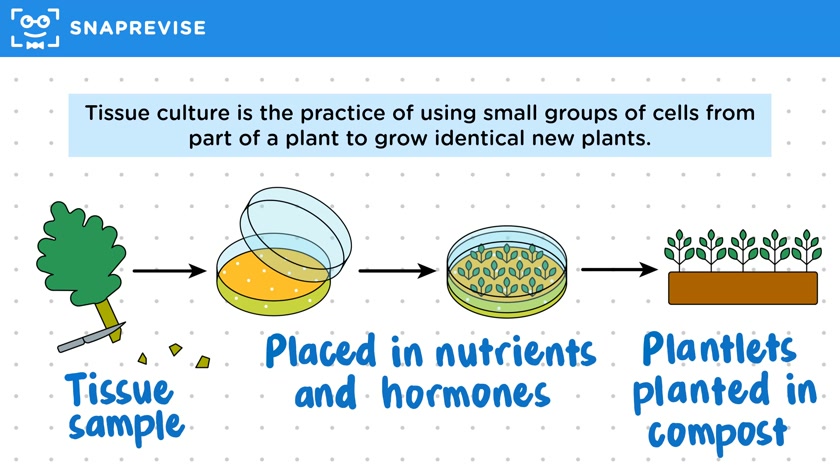
- Tissue culture involves using small groups of cells from a plant to grow identical new plants.
- The process starts by scraping a tissue sample from a plant.
- The cells are placed in a Petri dish with agar jelly, nutrients, and plant hormones to stimulate growth.
- This environment allows the growth of tiny plantlets.
- These plantlets are then transferred to compost to mature into full plants.
- Tissue culture is likened to growing a culture of bacteria, but with plant tissue.
- It is a more complex process than taking cuttings.
- Tissue culture is crucial for preserving rare plant species, as taking cuttings could harm the plant.
- It is also significant commercially in plant nurseries to produce large quantities of plants efficiently.
- When scaled up, tissue culture can be more efficient than taking cuttings.
Please subscribe to access these revision notes.
This, and all other video notes, are included in our premium subscriptions.
Premium accounts get access to all videos and revision notes.
114
questions for Inheritance, variation and evolution
47
questions for Variation and evolution