
GCSE Biology (AQA)
331 videos | 14 hours
Please subscribe to watch this video.
This, and all other videos, are included in our premium subscriptions.
Premium accounts get access to all videos.
Enable autoplay to keep watching
Your browser is blocking videos from playing automatically. To turn it back on:
Safari (Mac): Click the Safari menu item in the top bar, then Settings → Websites → Auto-Play, then set Auto-Play to Allow All Auto-Play for the current website.
Safari (iPhone/iPad): open the Settings app, then Apps → Safari → Auto-Play, and select Allow All Auto-Play.
Transfer of Biomass
- Producers, primarily plants and algae, convert only about 1% of incident light energy into biomass through photosynthesis.
- Incident energy refers to the amount of energy striking the surface of plants or algae.
- The 1% energy conversion results in the production of glucose, which can be stored as starch or used to create other biological molecules like proteins, cellulose, fats, and oils.
- These molecules collectively contribute to the plant's biomass.
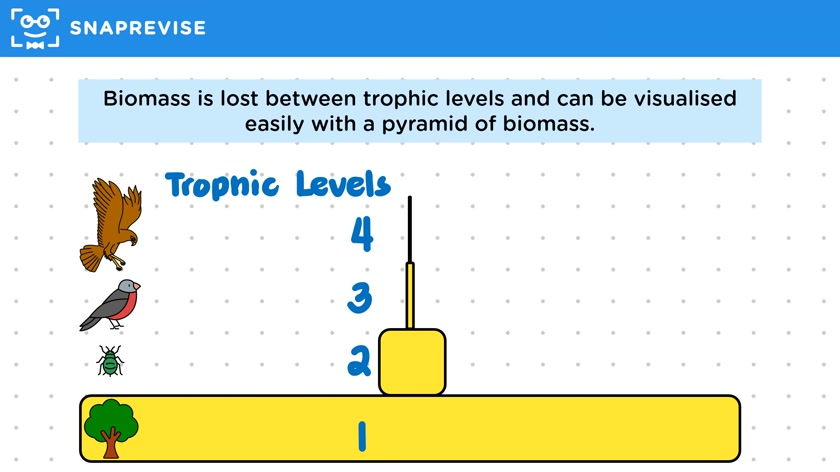
- Biomass is lost when transferred between trophic levels, which can be illustrated using a pyramid of biomass.
- As you move up the trophic levels, from trees at level one to hawks at level four, the total biomass decreases.
- Approximately 10% of the biomass from each trophic level is transferred to the next level.
- This results in a rapid decrease in biomass up the pyramid.
- For example, if a tree has a biomass of 100 kilograms, only 10 kilograms are transferred to the aphids, 1 kilogram from the aphids to the birds, and 0.1 kilograms from the birds to the hawk.
- This demonstrates a significant reduction in biomass from 100 kilograms at the tree level to just 0.1 kilograms at the hawk level.
Please subscribe to access these revision notes.
This, and all other video notes, are included in our premium subscriptions.
Premium accounts get access to all videos and revision notes.
61
questions for Ecology
15
questions for Trophic levels in an ecosystem (biology only)