
GCSE Chemistry (AQA)
196 videos | 19 hours
Please subscribe to watch this video.
This, and all other videos, are included in our premium subscriptions.
Premium accounts get access to all videos.
Enable autoplay to keep watching
Your browser is blocking videos from playing automatically. To turn it back on:
Safari (Mac): Click the Safari menu item in the top bar, then Settings → Websites → Auto-Play, then set Auto-Play to Allow All Auto-Play for the current website.
Safari (iPhone/iPad): open the Settings app, then Apps → Safari → Auto-Play, and select Allow All Auto-Play.
Advanced Ionic Bonding Diagrams
- Dot and cross diagrams can represent reactions with non-one-to-one ratios of metal and non-metal atoms.
- Lithium and oxygen react to form lithium oxide (Li2O), requiring two lithium atoms for each oxygen atom.
- In a dot and cross diagram, lithium atoms are represented with dots, and oxygen atoms with crosses.
- Each lithium atom loses one electron, transferring them to the oxygen atom's outer shell.
- Electron configurations may not be provided in exams, requiring calculation before drawing.
- Multiple ions of the same type can be represented with a number in front of a bracket.
- Drawing one lithium ion and writing "2" in front of the bracket is faster than drawing two separate ions.
- This method is only applicable for ions at the end, not atoms at the beginning.
- The reaction is shown with two lithium atoms reacting with one oxygen atom to form two lithium ions and one oxide ion.
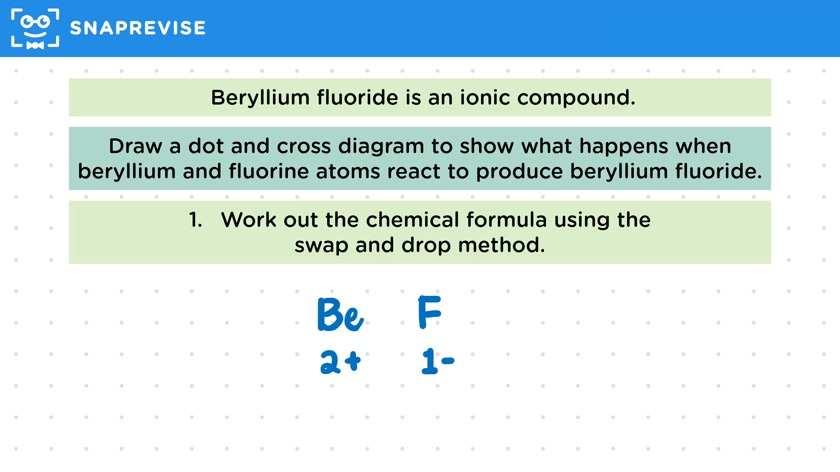
- Beryllium fluoride is another ionic compound example.
- The chemical formula for beryllium fluoride is BeF2, determined using the swap and drop method.
- Beryllium forms ions with a 2+ charge, and fluorine forms ions with a 1- charge.
- Electron configurations for beryllium and fluorine are 2,2 and 2,7, respectively.
- Dot and cross diagrams show one beryllium atom and two fluorine atoms.
- Beryllium loses two electrons, transferring one to each fluorine atom.
- Beryllium ion has a 2+ charge, and fluoride ions have a 1- charge.
- Two fluoride ions are indicated with a "2" in front of the bracket.
- The fluoride ion is distinct from the fluorine ion.
- The full reaction is depicted with beryllium reacting with two fluorine atoms to form one beryllium ion and two fluoride ions.
Please subscribe to access these revision notes.
This, and all other video notes, are included in our premium subscriptions.
Premium accounts get access to all videos and revision notes.
40
questions for Bonding, structure, and the properties of matter
13
questions for Chemical bonds, ionic, covalent and metallic