
GCSE Chemistry (AQA)
196 videos | 19 hours
Please subscribe to watch this video.
This, and all other videos, are included in our premium subscriptions.
Premium accounts get access to all videos.
Enable autoplay to keep watching
Your browser is blocking videos from playing automatically. To turn it back on:
Safari (Mac): Click the Safari menu item in the top bar, then Settings → Websites → Auto-Play, then set Auto-Play to Allow All Auto-Play for the current website.
Safari (iPhone/iPad): open the Settings app, then Apps → Safari → Auto-Play, and select Allow All Auto-Play.
Amino acids, Polypeptides & Proteins
- Amino acids are molecules with two different functional groups.
- They are essential for protein synthesis.
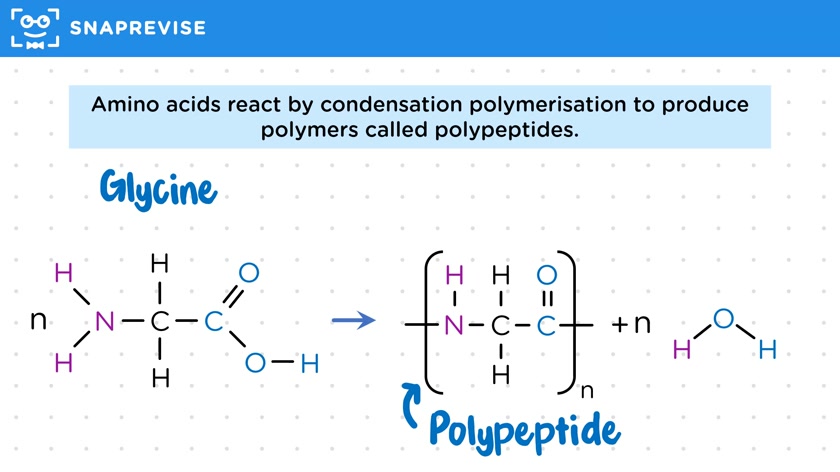
- The simplest amino acid is glycine.
- Glycine has two functional groups: an amine group (NH2) and a carboxylic acid group (COOH).
- Amino acids can be distinguished by their unique R groups.
- Amino acids undergo condensation polymerization to form polypeptides.
- Condensation polymerization joins molecules with two functional groups into a polymer, producing small molecules like water.
- Polypeptides are naturally occurring polymers essential for life.
- Poly glycine is an example of a polymer formed from glycine.
- In polymerization, each glycine molecule loses a hydrogen from the amine group and an OH from the carboxylic acid group, forming water.
- Different amino acids can combine to form proteins.
- The sequence and order of amino acids in a protein determine its properties.
- Proteins are important for life and include enzymes, which act as biological catalysts.
- Enzymes help break down or combine reactant molecules.
Please subscribe to access these revision notes.
This, and all other video notes, are included in our premium subscriptions.
Premium accounts get access to all videos and revision notes.
83
questions for Organic chemistry
19
questions for Synthetic and naturally occurring polymers (chemistry only)