
GCSE Chemistry (AQA)
196 videos | 19 hours
Please subscribe to watch this video.
This, and all other videos, are included in our premium subscriptions.
Premium accounts get access to all videos.
Enable autoplay to keep watching
Your browser is blocking videos from playing automatically. To turn it back on:
Safari (Mac): Click the Safari menu item in the top bar, then Settings → Websites → Auto-Play, then set Auto-Play to Allow All Auto-Play for the current website.
Safari (iPhone/iPad): open the Settings app, then Apps → Safari → Auto-Play, and select Allow All Auto-Play.
Carboxylic Acid Names & Formulae
- Carboxylic acids are a homologous series with the functional group COOH.
- A homologous series is a family of compounds with the same general formula, functional group, and similar chemical reactions.
- Carboxylic acids can be made by reacting an alcohol with an oxidizing agent.
- The carbon bonded to the OH group forms a double bond with another oxygen atom, creating the carboxylic acid functional group.
- This functional group determines the properties of the molecule.
- Carboxylic acids are joined to a hydrocarbon chain, often represented by the letter R.
- Familiarity with the first four carboxylic acids is important for exams.
- Prefixes like meth and eth indicate the number of carbons in the compound, while the suffix "oic acid" denotes carboxylic acids.
- In molecular formulas, COOH is written separately to highlight the carboxylic acid group.
- Ethanoic acid, commonly known as vinegar, is a familiar carboxylic acid with two carbons.
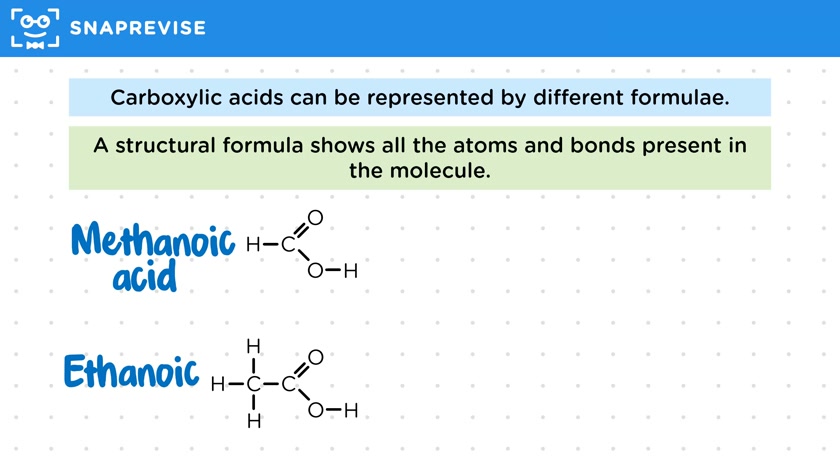
- Carboxylic acids can be represented by different formulas, including molecular and structural formulas.
- Structural formulas show all atoms and bonds in the molecule.
- Methanoic acid has one carbon, ethanoic acid has two, propanoic acid has three, and butanoic acid has four carbons.
- Semi-structural or condensed structural formulas show the order of bonded atoms without drawing all bonds.
- Methanoic acid is written as H-C-O-O-H, ethanoic acid as CH3COOH, propanoic acid as CH3CH2COOH, and butanoic acid as CH3CH2CH2COOH.
- Larger acids have more CH2 groups.
- Recognizing and understanding condensed structural formulas is important for exams.
Please subscribe to access these revision notes.
This, and all other video notes, are included in our premium subscriptions.
Premium accounts get access to all videos and revision notes.
83
questions for Organic chemistry
33
questions for Reactions of alkenes and alcohols (chemistry only)