
GCSE Chemistry (AQA)
196 videos | 19 hours
Please subscribe to watch this video.
This, and all other videos, are included in our premium subscriptions.
Premium accounts get access to all videos.
Enable autoplay to keep watching
Your browser is blocking videos from playing automatically. To turn it back on:
Safari (Mac): Click the Safari menu item in the top bar, then Settings → Websites → Auto-Play, then set Auto-Play to Allow All Auto-Play for the current website.
Safari (iPhone/iPad): open the Settings app, then Apps → Safari → Auto-Play, and select Allow All Auto-Play.
Crystallisation
- Crystallization is a process used to separate mixtures, specifically a dissolved substance from a solvent.
- Example setup: separating copper sulfate from water using a crystallization dish.
- During crystallization, water evaporates, leaving solid copper sulfate crystals.
- Crystallization is a physical process, not involving a chemical reaction, and no new substances are made.
- The process involves changing the physical state of substances, not their chemical composition.
- Step-by-step process:
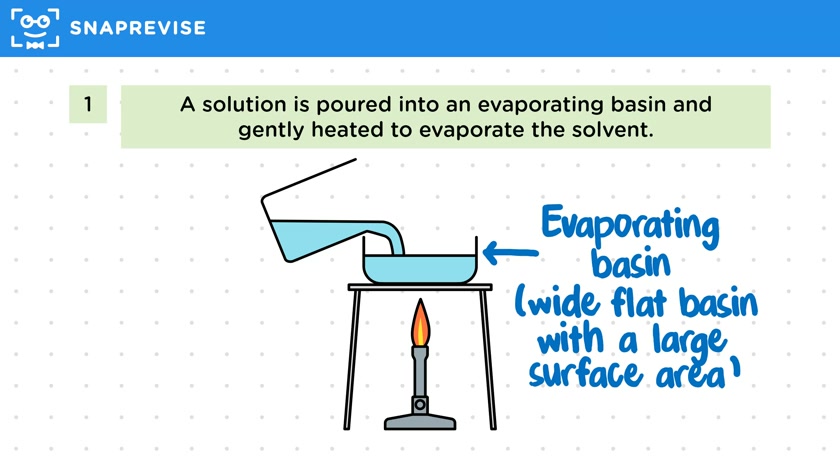
- Step 1: Pour solution into an evaporating basin and gently heat to evaporate the solvent.
- Use a wide, flat evaporating basin for better evaporation.
- Heat the solution gently with a bunsen burner.
- Step 2: As the solvent evaporates, crystals begin to form.
- The solution becomes more concentrated as water evaporates.
- Crystals form, and their color depends on the dissolved solid.
- Turn off the bunsen burner when water level is low to avoid damaging crystals.
- Remaining solvent evaporates slowly, leaving only crystals.
- Step 3: Once solvent evaporates, dry crystals by patting with filter paper.
- Scrape crystals out of the basin and pat dry to remove remaining solvent.
- Final product: dry crystals.
Please subscribe to access these revision notes.
This, and all other video notes, are included in our premium subscriptions.
Premium accounts get access to all videos and revision notes.
60
questions for Atomic structure and the periodic table
52
questions for A simple model of the atom, symbols, relative atomic mass, electronic charge and isotopes