
GCSE Chemistry (AQA)
196 videos | 19 hours
Please subscribe to watch this video.
This, and all other videos, are included in our premium subscriptions.
Premium accounts get access to all videos.
Enable autoplay to keep watching
Your browser is blocking videos from playing automatically. To turn it back on:
Safari (Mac): Click the Safari menu item in the top bar, then Settings → Websites → Auto-Play, then set Auto-Play to Allow All Auto-Play for the current website.
Safari (iPhone/iPad): open the Settings app, then Apps → Safari → Auto-Play, and select Allow All Auto-Play.
Diamond
- Diamond is a giant covalent structure consisting of only carbon atoms.
- Diamond is made up entirely of covalently bonded carbon atoms.
- Each carbon atom in diamond is bonded to four other carbon atoms by strong covalent bonds.
- The structure of diamond is tetrahedral.
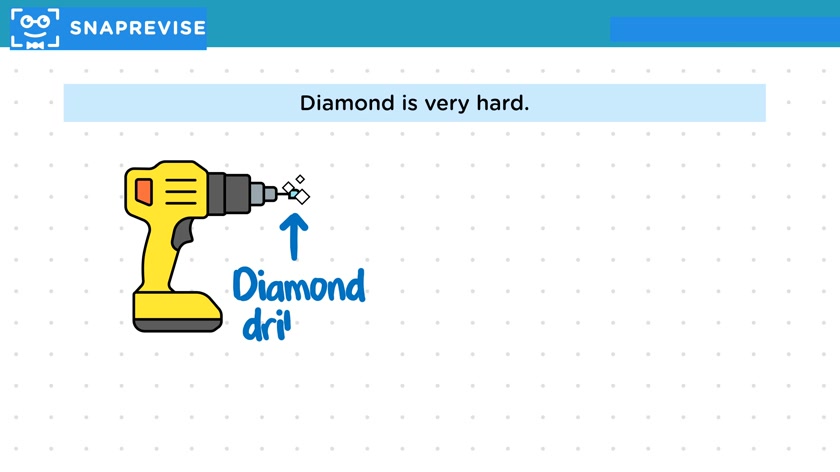
- Diamond is very hard, the hardest material in the world, and has many industrial applications.
- The carbon atoms in diamond form a rigid, extensive network with many covalent bonds.
- Diamond has a very high melting point, around 4,000 degrees Celsius.
- A lot of energy is required to break the strong covalent bonds in diamond.
- Diamond cannot conduct electricity because there are no free charged particles.
- In diamond, all outer electrons of carbon atoms are used in bonding, leaving no free electrons to move through the structure.
Please subscribe to access these revision notes.
This, and all other video notes, are included in our premium subscriptions.
Premium accounts get access to all videos and revision notes.
40
questions for Bonding, structure, and the properties of matter
4
questions for How bonding and structure are related to the properties of substances