
GCSE Chemistry (AQA)
196 videos | 19 hours
Please subscribe to watch this video.
This, and all other videos, are included in our premium subscriptions.
Premium accounts get access to all videos.
Enable autoplay to keep watching
Your browser is blocking videos from playing automatically. To turn it back on:
Safari (Mac): Click the Safari menu item in the top bar, then Settings → Websites → Auto-Play, then set Auto-Play to Allow All Auto-Play for the current website.
Safari (iPhone/iPad): open the Settings app, then Apps → Safari → Auto-Play, and select Allow All Auto-Play.
Electron Configuration and the Periodic Table
- The electronic structure of an element is connected to its position in the periodic table.
- The periodic table is arranged with each symbol representing a different element.
- The period number of an element is the same as the number of electron shells it has.
- Periods are the rows on the periodic table; the first row includes hydrogen and helium.
- Lithium, in the second period, has two electron shells.
- The group number of an element is the number of electrons in its outer shell.
- Groups are the columns on the periodic table, numbered from left to right.
- Lithium is in group one, meaning it has one electron in its outer shell.
- The number of outer shell electrons determines the reactions that elements undergo.
- Chlorine has seven electrons in its outer shell, affecting its reactivity.
- Elements in the same group have similar chemical properties due to the same number of outer electrons.
- You need to use the periodic table to derive information about the structures of the first 20 elements and all elements in groups one and seven.
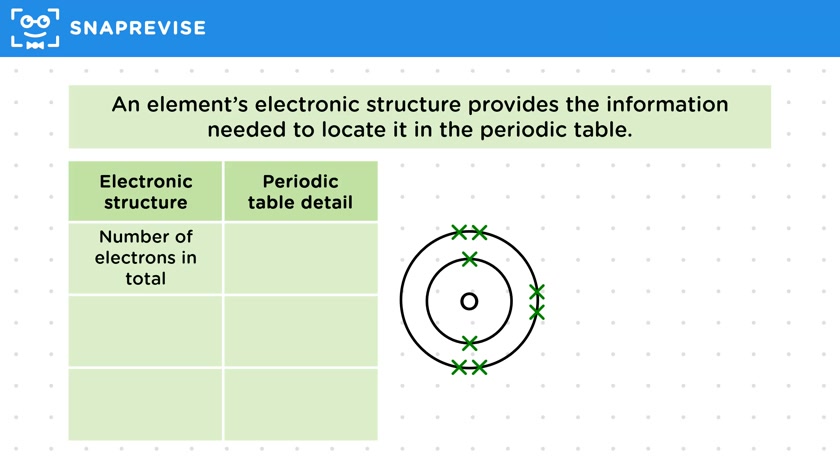
- An element's electronic structure helps locate it in the periodic table.
- Oxygen has eight electrons, making it the eighth element in the periodic table.
- The number of shells in an atom tells its period number; oxygen has two shells, so it's in period two.
- The number of electrons in the outer shell indicates the group number; oxygen has six outer electrons, placing it in group six.
- Example: Silicon's electron configuration is 2 8 4.
- Group number: 4 (four outer shell electrons).
- Period number: 3 (three shells).
- Atomic number: 14 (total electrons).
- Silicon's position in the periodic table: group four, period three, atomic number 14.
Please subscribe to access these revision notes.
This, and all other video notes, are included in our premium subscriptions.
Premium accounts get access to all videos and revision notes.
60
questions for Atomic structure and the periodic table
5
questions for The periodic table