
GCSE Chemistry (AQA)
196 videos | 19 hours
Please subscribe to watch this video.
This, and all other videos, are included in our premium subscriptions.
Premium accounts get access to all videos.
Enable autoplay to keep watching
Your browser is blocking videos from playing automatically. To turn it back on:
Safari (Mac): Click the Safari menu item in the top bar, then Settings → Websites → Auto-Play, then set Auto-Play to Allow All Auto-Play for the current website.
Safari (iPhone/iPad): open the Settings app, then Apps → Safari → Auto-Play, and select Allow All Auto-Play.
Energy in Bonds
- Energy must be supplied to break bonds in reactants during a chemical reaction.
- Example: Reaction between a carbon atom and an oxygen molecule requires breaking bonds between oxygen atoms.
- Energy is needed to break bonds, similar to pulling apart two magnets.
- Energy is transferred into the system to break bonds.
- Energy is released when new bonds are formed in the products.
- Example: Carbon and oxygen form new bonds to make carbon dioxide, releasing energy.
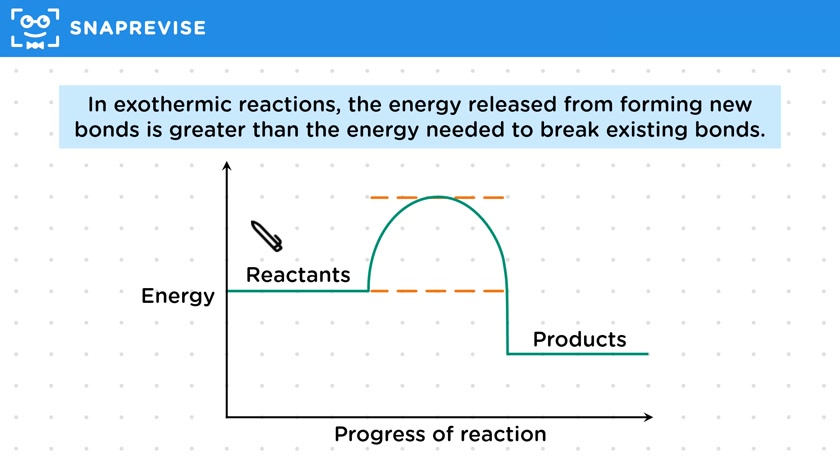
- Exothermic reactions release more energy from forming new bonds than is needed to break existing bonds.
- Exothermic reactions transfer energy to the surroundings.
- Reaction profile graph shows energy changes during a reaction.
- Energy needed for bond breaking is less than energy released in bond making in exothermic reactions.
- Endothermic reactions require more energy to break existing bonds than is released from forming new bonds.
- Endothermic reactions take in energy from the surroundings.
- Reaction profile graph for endothermic reactions shows more energy is needed for bond breaking than is released in bond making.
Please subscribe to access these revision notes.
This, and all other video notes, are included in our premium subscriptions.
Premium accounts get access to all videos and revision notes.
50
questions for Energy changes
29
questions for Exothermic and endothermic reactions