
GCSE Chemistry (AQA)
196 videos | 19 hours
Please subscribe to watch this video.
This, and all other videos, are included in our premium subscriptions.
Premium accounts get access to all videos.
Enable autoplay to keep watching
Your browser is blocking videos from playing automatically. To turn it back on:
Safari (Mac): Click the Safari menu item in the top bar, then Settings → Websites → Auto-Play, then set Auto-Play to Allow All Auto-Play for the current website.
Safari (iPhone/iPad): open the Settings app, then Apps → Safari → Auto-Play, and select Allow All Auto-Play.
Factors Affecting Concentration
- The concentration of a solution can be changed by altering the quantity of solute or solvent.
- A solution consists of solid solute particles mixed with a liquid solvent.
- Concentration measures how tightly packed solute particles are, calculated using the equation: C = M/V.
- M represents the mass of solute, and V represents the volume of solvent.
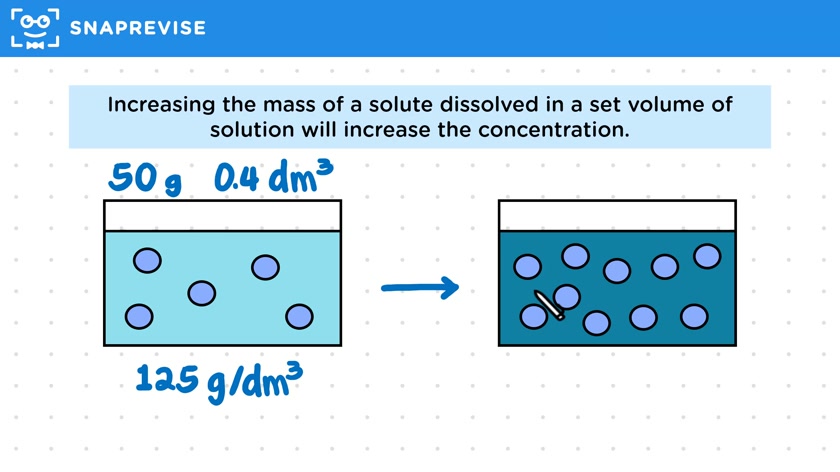
- Example: Dissolving 50 grams of solute in 0.4 decimeters cubed of solvent results in a concentration of 125 grams per decimeter cubed.
- For exams, you need to calculate concentration and explain how to change it.
- Concentration depends on mass and volume.
- Increasing the mass of solute in a set volume increases concentration.
- Adding more solute particles makes them packed closer, increasing concentration.
- Doubling the mass of solute doubles the concentration.
- Removing solute without changing solvent volume decreases concentration.
- Decreasing solvent volume increases concentration.
- Evaporating solvent reduces its volume, increasing concentration.
- Example: Evaporating half the solvent results in a concentration of 250 grams per decimeter cubed.
- Halving the solvent volume doubles the concentration.
- Adding more solvent without changing solute decreases concentration.
Please subscribe to access these revision notes.
This, and all other video notes, are included in our premium subscriptions.
Premium accounts get access to all videos and revision notes.
19
questions for Quantitative chemistry
13
questions for Use of amount of substance in relation to masses of pure substances