
GCSE Chemistry (AQA)
196 videos | 19 hours
Please subscribe to watch this video.
This, and all other videos, are included in our premium subscriptions.
Premium accounts get access to all videos.
Enable autoplay to keep watching
Your browser is blocking videos from playing automatically. To turn it back on:
Safari (Mac): Click the Safari menu item in the top bar, then Settings → Websites → Auto-Play, then set Auto-Play to Allow All Auto-Play for the current website.
Safari (iPhone/iPad): open the Settings app, then Apps → Safari → Auto-Play, and select Allow All Auto-Play.
Gas Volume Calculations
- Every mole of any gas has the same volume under the same temperature and pressure.
- This fact simplifies calculations involving gases.
- The volume of gas reactants and products can be calculated from balanced symbol equations.
- Example reaction: H2 + Cl2 ��� 2 HCl.
- The balanced equation shows the ratio of moles and can be used to calculate gas volumes.
- If 100 cm�� of hydrogen is used, the same volume of chlorine is used, and 200 cm�� of hydrogen chloride is produced.
- This method works in reverse if the volume of a product is known.
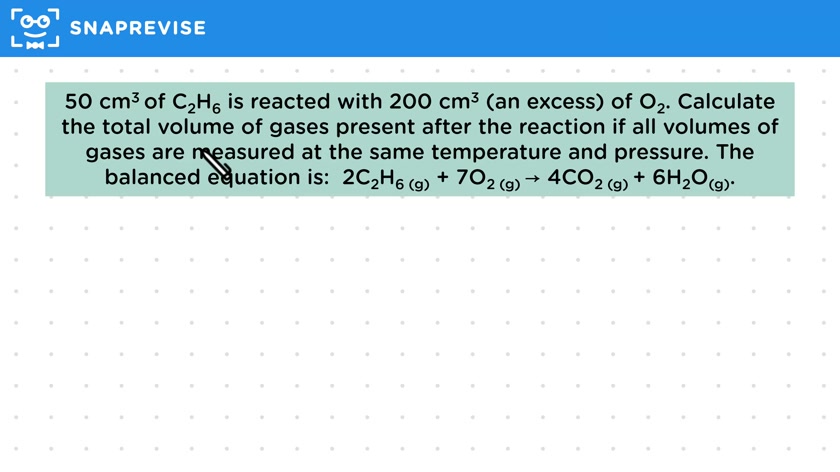
- Example problem: 50 cm�� of C2H6 reacts with 200 cm�� of O2.
- Oxygen is in excess, so not all of it reacts.
- The balanced equation: 2 C2H6 + 7 O2 ��� 4 CO2 + 6 H2O.
- Mole ratio: 2:7:4:6.
- Calculate the volume of O2 that reacts with C2H6: 50 cm�� x (7/2) = 175 cm��.
- Remaining O2 volume: 200 cm�� - 175 cm�� = 25 cm��.
- Calculate volumes of CO2 and H2O produced using the mole ratio.
- CO2 volume: 50 cm�� x 2 = 100 cm��.
- H2O volume: 50 cm�� x 3 = 150 cm��.
- Total volume of gases after reaction: 25 + 100 + 150 = 275 cm��.
Please subscribe to access these revision notes.
This, and all other video notes, are included in our premium subscriptions.
Premium accounts get access to all videos and revision notes.
19
questions for Quantitative chemistry
1
questions for Use of amount of substance in relation to volumes of gases (chemistry only) (HT only)