
GCSE Chemistry (AQA)
196 videos | 19 hours
Please subscribe to watch this video.
This, and all other videos, are included in our premium subscriptions.
Premium accounts get access to all videos.
Enable autoplay to keep watching
Your browser is blocking videos from playing automatically. To turn it back on:
Safari (Mac): Click the Safari menu item in the top bar, then Settings → Websites → Auto-Play, then set Auto-Play to Allow All Auto-Play for the current website.
Safari (iPhone/iPad): open the Settings app, then Apps → Safari → Auto-Play, and select Allow All Auto-Play.
General Formulae of Alkanes
- Most hydrocarbons in crude oil are called alkanes.
- Hydrocarbons are organic compounds consisting only of carbon and hydrogen atoms.
- Alkanes form a homologous series, a family of compounds with similar chemical properties and the same general formula.
- The general formula for alkanes is CnH2n+2, where n is the number of carbon atoms.
- The first four alkanes are methane (CH4), ethane (C2H6), propane (C3H8), and butane (C4H10).
- Each successive alkane has one more carbon atom and two more hydrogen atoms.
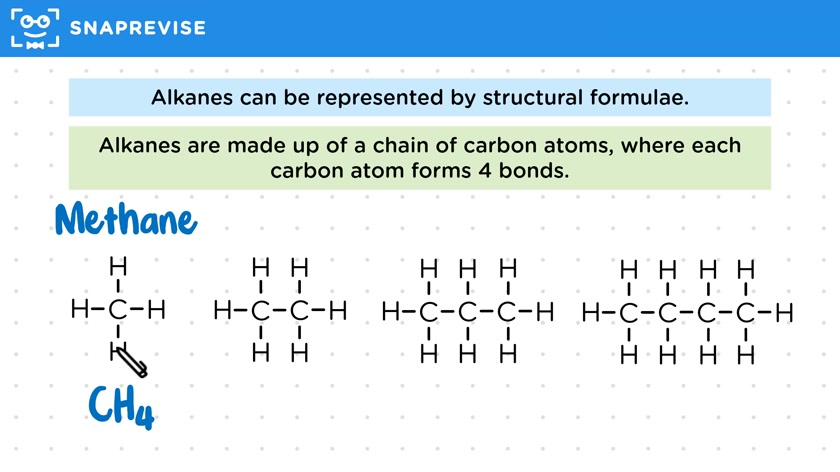
- Alkanes can be represented by structural formulas, showing atoms and bonds.
- Alkanes are made up of a chain of carbon atoms, each forming four bonds.
- Methane has one carbon atom bonded to four hydrogens.
- Ethane has two carbon atoms, each bonded to three hydrogens, with the last bond between the carbons.
- Propane has three carbon atoms, with the middle carbon bonded to two hydrogens and the end carbons bonded to three hydrogens each.
- Butane has four carbon atoms, with two end carbons bonded to three hydrogens and two middle carbons bonded to two hydrogens.
- The pattern repeats for longer alkanes, with additional middle carbons bonded to two hydrogens.
- The names of alkanes end in "ane," and the prefix indicates the number of carbon atoms.
- Drawing structural formulas involves creating a carbon chain and adding hydrogens to satisfy the four-bond rule for carbon.
- Example: For propane, the molecular formula is C3H8, and the structural formula involves a chain of three carbons with appropriate hydrogen bonds.
Please subscribe to access these revision notes.
This, and all other video notes, are included in our premium subscriptions.
Premium accounts get access to all videos and revision notes.
83
questions for Organic chemistry
31
questions for Carbon compounds as fuels and feedstock