
GCSE Chemistry (AQA)
196 videos | 19 hours
Please subscribe to watch this video.
This, and all other videos, are included in our premium subscriptions.
Premium accounts get access to all videos.
Enable autoplay to keep watching
Your browser is blocking videos from playing automatically. To turn it back on:
Safari (Mac): Click the Safari menu item in the top bar, then Settings → Websites → Auto-Play, then set Auto-Play to Allow All Auto-Play for the current website.
Safari (iPhone/iPad): open the Settings app, then Apps → Safari → Auto-Play, and select Allow All Auto-Play.
Group 1: Alkali Metals
- Group one elements are metals found in the first column of the periodic table, known as alkali metals.
- These elements are very reactive and react with water, oxygen, and group seven elements.
- Reactions involving group one elements can be dangerous and require caution.
- Cesium reacting with water can produce a violent explosion.
- Group one elements have one electron in their outer shell, which gives them characteristic properties.
- Lithium, sodium, and potassium are the first three members of group one, with 3, 11, and 19 electrons respectively.
- These elements react by losing their single outer electron, forming a positive ion with a plus one charge.
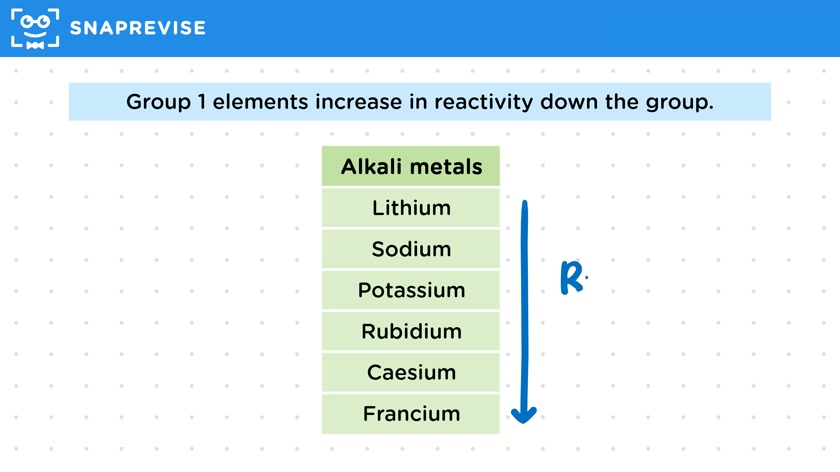
- Reactivity increases down the group, with lithium being the least reactive and francium the most reactive.
- Atoms increase in size down the group, making the outer electron further from the nucleus and less attracted, thus more easily lost.
- Alkaline metals are soft, can be cut with a knife, have low density, and float on water.
- They have relatively low melting and boiling points compared to other metals.
- Group one metals have melting points below other metals, with sodium and potassium having melting points below 100 degrees Celsius.
- Melting points decrease down the group, and trends can be used to predict properties of other group one metals.
- Predictions of properties, such as melting points, can be made based on trends, with a range of acceptable answers in exams.
Please subscribe to access these revision notes.
This, and all other video notes, are included in our premium subscriptions.
Premium accounts get access to all videos and revision notes.
60
questions for Atomic structure and the periodic table
5
questions for The periodic table