
GCSE Chemistry (AQA)
196 videos | 19 hours
Please subscribe to watch this video.
This, and all other videos, are included in our premium subscriptions.
Premium accounts get access to all videos.
Enable autoplay to keep watching
Your browser is blocking videos from playing automatically. To turn it back on:
Safari (Mac): Click the Safari menu item in the top bar, then Settings → Websites → Auto-Play, then set Auto-Play to Allow All Auto-Play for the current website.
Safari (iPhone/iPad): open the Settings app, then Apps → Safari → Auto-Play, and select Allow All Auto-Play.
H+ Concentration and pH
- Concentration measures the mass or amount of solute in a given volume of solvent or solution.
- Solutions with the same volume can have different concentrations based on the number of solute particles.
- Low concentration solutions have fewer solute particles spread out, while high concentration solutions have more particles packed together.
- pH measures the concentration of hydrogen ions (H+) in a solution.
- pH values are associated with color changes when using a universal indicator, ranging from red to green to purple as pH increases.
- A neutral solution has equal numbers of H+ and OH- ions, with a pH of 7, like pure water.
- Higher H+ concentration results in lower pH, making a solution more acidic.
- Higher OH- concentration results in higher pH, making a solution more alkaline.
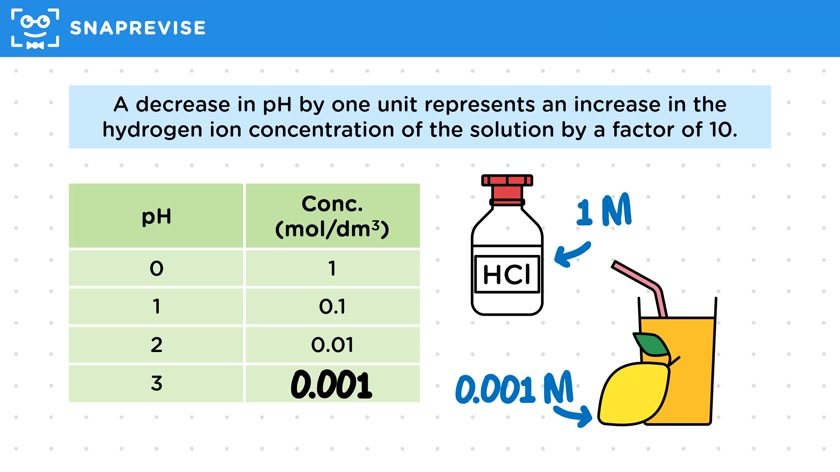
- The pH scale is logarithmic; a decrease by one unit increases H+ concentration by a factor of 10.
- Concentration is measured in moles per decimeter cubed (M).
- Acids and alkalis can be described as concentrated or dilute based on the amount of dissolved solute.
- Strong acids, like hydrochloric acid, are completely ionized in solution, while weak acids, like acetic acid, are only partially ionized.
- Strong acids have lower pH values due to higher H+ concentration compared to weak acids at the same concentration.
- Examples of strong acids include hydrochloric acid, nitric acid, and sulfuric acid.
- Examples of weak acids include acetic acid, citric acid, and carbonic acid.
- Strong acids are commonly found in laboratories and must be handled with care.
- Weak acids are often found in everyday items like vinegar, lemons, and fizzy drinks.
- The strength of an acid affects its pH; stronger acids have lower pH values.
Please subscribe to access these revision notes.
This, and all other video notes, are included in our premium subscriptions.
Premium accounts get access to all videos and revision notes.
80
questions for Chemical changes
30
questions for Reactions of acids