
GCSE Chemistry (AQA)
196 videos | 19 hours
Please subscribe to watch this video.
This, and all other videos, are included in our premium subscriptions.
Premium accounts get access to all videos.
Enable autoplay to keep watching
Your browser is blocking videos from playing automatically. To turn it back on:
Safari (Mac): Click the Safari menu item in the top bar, then Settings → Websites → Auto-Play, then set Auto-Play to Allow All Auto-Play for the current website.
Safari (iPhone/iPad): open the Settings app, then Apps → Safari → Auto-Play, and select Allow All Auto-Play.
Ionic Equations
- Ionic compounds dissolve in water, separating into ions surrounded by water molecules.
- Water consists of H2O molecules with oxygen covalently bonded to two hydrogen atoms.
- Silver nitrate is an ionic compound with positively charged silver ions and negatively charged nitrate ions.
- When dissolved, silver and nitrate ions are surrounded by water molecules, forming aqueous silver nitrate.
- In reactions with aqueous ionic compounds, not all ions react; water molecules typically aren't involved.
- Adding potassium bromide to the solution introduces positive potassium and negative bromide ions.
- Bromide and silver ions bond to form solid silver bromide, which precipitates out of the solution.
- Remaining potassium and nitrate ions are dissolved in water, forming aqueous potassium nitrate.
- Spectator ions, like potassium and nitrate, do not react and remain unchanged.
- Ionic equations focus on ions that react, excluding spectator ions.
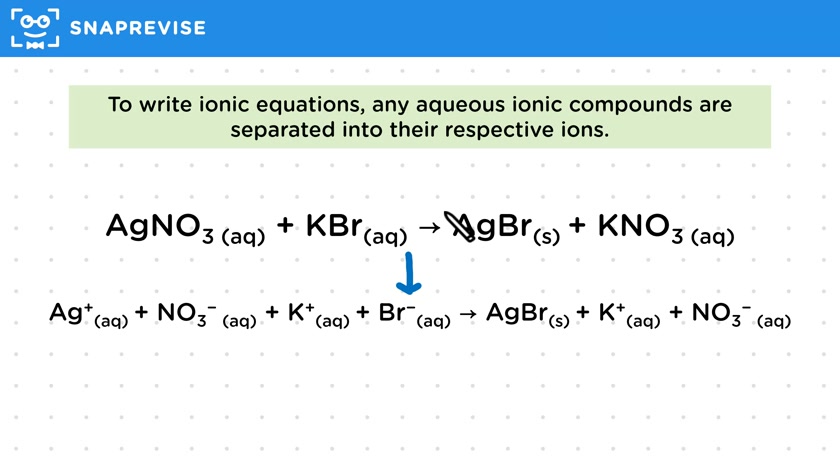
- Writing ionic equations involves separating aqueous ionic compounds into ions.
- In exams, balanced non-ionic equations are provided for writing ionic equations.
- Example: Silver nitrate and potassium bromide react to form silver bromide and potassium nitrate.
- Spectator ions are identified and removed to focus on reacting ions.
- Example: Aluminum and copper chloride reaction involves electron transfer, not just ion formation.
Please subscribe to access these revision notes.
This, and all other video notes, are included in our premium subscriptions.
Premium accounts get access to all videos and revision notes.
80
questions for Chemical changes
29
questions for Reactivity of metals