
GCSE Chemistry (AQA)
196 videos | 19 hours
Please subscribe to watch this video.
This, and all other videos, are included in our premium subscriptions.
Premium accounts get access to all videos.
Enable autoplay to keep watching
Your browser is blocking videos from playing automatically. To turn it back on:
Safari (Mac): Click the Safari menu item in the top bar, then Settings → Websites → Auto-Play, then set Auto-Play to Allow All Auto-Play for the current website.
Safari (iPhone/iPad): open the Settings app, then Apps → Safari → Auto-Play, and select Allow All Auto-Play.
Limiting Reactants Calculations
- The limiting reactant determines the amount of product formed in a chemical reaction.
- The reaction stops when the limiting reactant is used up, and other reactants are in excess.
- Example: In bread making, flour can be the limiting reactant.
- Reacting mass calculations help determine the mass of product formed by identifying the limiting reactant.
- Example calculation: Reaction between magnesium and sulfuric acid to find maximum hydrogen mass.
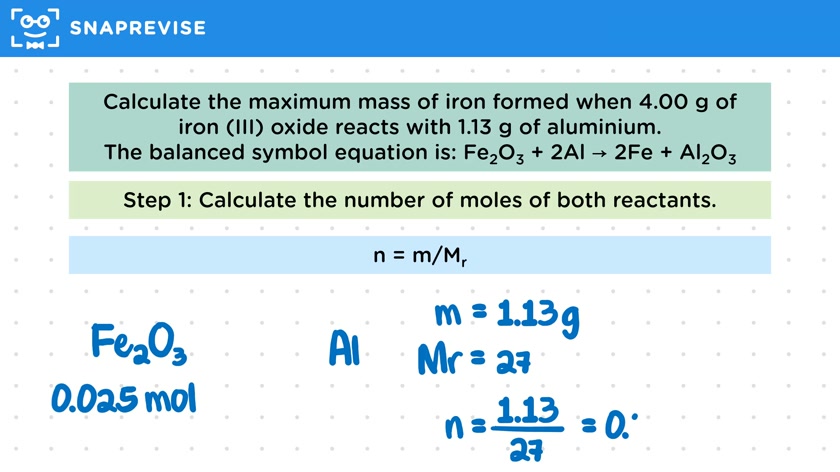
- Steps to calculate maximum mass of iron from iron oxide and aluminum:
- 1. Calculate moles of both reactants using moles = mass / relative formula mass.
- 2. Identify the limiting reactant using the balanced equation ratio.
- 3. Use the ratio between limiting reactant and product to find moles of product.
- 4. Calculate the mass of the product using mass = moles x relative formula mass.
- Example: Iron oxide and aluminum reaction, aluminum is the limiting reactant.
- Final calculation: Maximum mass of iron formed is 2.35 grams.
- Understanding the effect of a limiting reactant is crucial for exams, in terms of moles or masses in grams.
Please subscribe to access these revision notes.
This, and all other video notes, are included in our premium subscriptions.
Premium accounts get access to all videos and revision notes.
19
questions for Quantitative chemistry
13
questions for Use of amount of substance in relation to masses of pure substances